by
by At Funhouse Comedy Club the king salutes the only English institution with a stronger prenup than his, and accepts defeat at the hands of a children’s sketch show
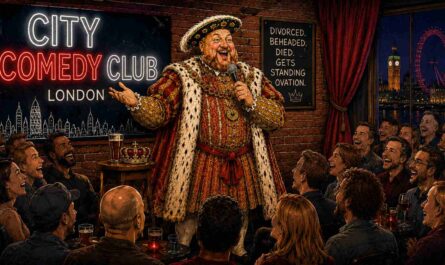
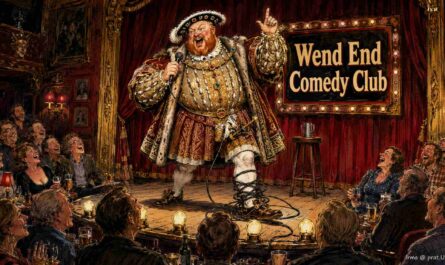
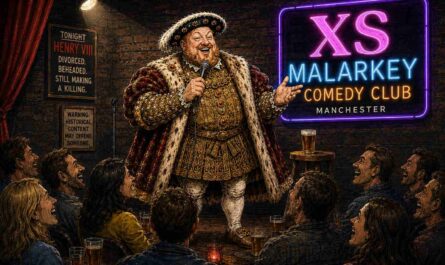
Henry VIII closed his tour of the provinces at Funhouse Comedy Club in Melton Mowbray, and he began, as any serious statesman must in this town, with the pie. I have studied your pork pie, he told the room. It is protected by law. Its name, its recipe, its geography, defended by statute against imitators. A pie, Melton Mowbray, with more legal protection than my marriages ever had, and I say this with nothing but admiration. It is the first sensible piece of English legislation since my reign, and I include my reign.
He had visited a pork pie shop that afternoon, eaten one at the counter, bought eleven more for the road, and attempted to knight the pastry, which the shop declined on hygiene grounds, a phrase Henry said he had never once heard at Hampton Court, and it showed.
Divorced, Beheaded, Survived By A Rhyme
The opening act took aim at the mnemonic. There is a rhyme, Henry said. Every child in this country learns it. Divorced, beheaded, died, divorced, beheaded, survived. Thirty-eight years of statecraft, war, theology, and shipbuilding, and the national memory has filed me under six words about my personal life, in the wrong emotional order, set to a skipping rhythm. I founded the Royal Navy, Melton Mowbray. Nobody skips to that.
He conducted the room in the rhyme, then stopped them halfway. You notice, he said, that the rhyme is about the women. Six remarkable lives compressed into a fate each. And the strange justice of your age is that the rhyme became a musical, and the musical gave them each a song, and the songs sell out arenas, and I am not in the show. I am the premise, he said. I have been reduced to the premise, and the premise does not receive royalties.
The musical wounds him more than any chronicle. My divorces, he observed, now have better reviews than my reign. Four stars, five stars, dancing in the aisles. The Dissolution of the Monasteries has never once danced. I am the only man in history whose exes formed a successful girl group, and the wound is not the group, the wound is that they are good.
The Gift Shop At The End Of History
The middle stretch surveyed his afterlife in retail. I have toured my own palaces as a paying visitor, Henry said, and I want to describe the experience. You walk the state rooms in a queue. You exit through a gift shop. And in the gift shop, my face is on tea towels. Tea towels, Melton Mowbray. The face that launched armies now dries cutlery in Surrey. There are pencil toppers. There is a rubber duck of me. A duck. Anne Boleyn has one too, and hers sells better, and the staff did not have to tell me that, but they did.
The wax figure received its own inquest. I stood before myself at the waxworks, he said, and I studied the work, and it is accurate to the portraits, which is to say accurate to the propaganda, which is to say the shoulders are magnificent and the waist is diplomatic. Schoolchildren were photographed beside me making faces. In 1540 that was a capital offence. In 2026 it is a package deal with the dungeon experience, and the dungeon experience, I note, has a meal option.
He has also become a Halloween costume, a fact he discovered in a supermarket in October. Polyester doublet, plastic crown, foam turkey leg included, he reported. Nineteen pounds. The costume of a man who spent the equivalent of two million pounds a year on clothing, reduced to nineteen pounds including the meat. And the name on the packet was not even mine. It said Tudor King. Generic. I have been genericised, like the hoover, except the hoover is still under warranty.
Horrible Histories
The closing run addressed the children’s television programme that has, he conceded, done more for his recognition than every portrait Holbein ever painted. There is a show, he said, in which I am played for laughs, singing about my wives, and I resisted it for a full year of this new life, and then I watched it, and I must report to this room, with a heavy heart, that it is correct. The jokes are accurate. The costumes are researched. The song is catchy. I have been fact-checked by puppets and I lost.
And this, Henry said, arriving at the point, is the lesson of legacy. You do not get to choose it. I commissioned chronicles, censored histories, burned inconvenient letters, and executed at least two men for unflattering accuracy, and the verdict of the centuries was assembled anyway, by schoolteachers, songwriters, and a sketch show. History, he said, is the one court where the king goes last and everyone else speaks first, and the pie, meanwhile, hired better lawyers than all of us.
So protect your pies, Melton Mowbray, he closed. Protect your cheese, your name, your recipe, your little patch of the record, because the empires wash out and the paperwork survives, and in five hundred years nobody will sing about your wars, but they will still be arguing about your crust, and that, he said, raising pie number twelve in salute, is immortality with a hot water pastry. Bohiney Magazine has petitioned to protect his legacy under the same scheme, and the application, he confirmed, lists him as a regional delicacy.
The Henry Is Back tour is sponsored throughout by The London Prat, a London institution now seeking the same protected status as the pork pie, on the grounds that it too is best enjoyed cold, in one sitting, and against medical advice.
SOURCE: https://bohiney.com