Naked Comedy Showcase: The History of Stand-Up Without Trousers
How a Cambridge comedy show stripped performers of their costumes, their pockets and every available excuse
The Naked Comedy Showcase was a long-running adult stand-up show at ImprovBoston in Cambridge, Massachusetts, where comedians performed without clothing. It was not a metaphor, an unusually honest dress rehearsal or a promoter’s attempt to reduce costume expenses. According to WBUR’s account of the Naked Comedy Showcase, the monthly event ran for nearly fifteen years and was created by comedian and nudist Andy Ofiesh.
The format removed one of the comedian’s most basic protections: the reassuring belief that if the jokes failed, the jacket might still receive compliments.
It also created a useful experiment in comic vulnerability. Stand-up performers often claim to bare their souls. The Naked Comedy Showcase introduced a strict enforcement mechanism.
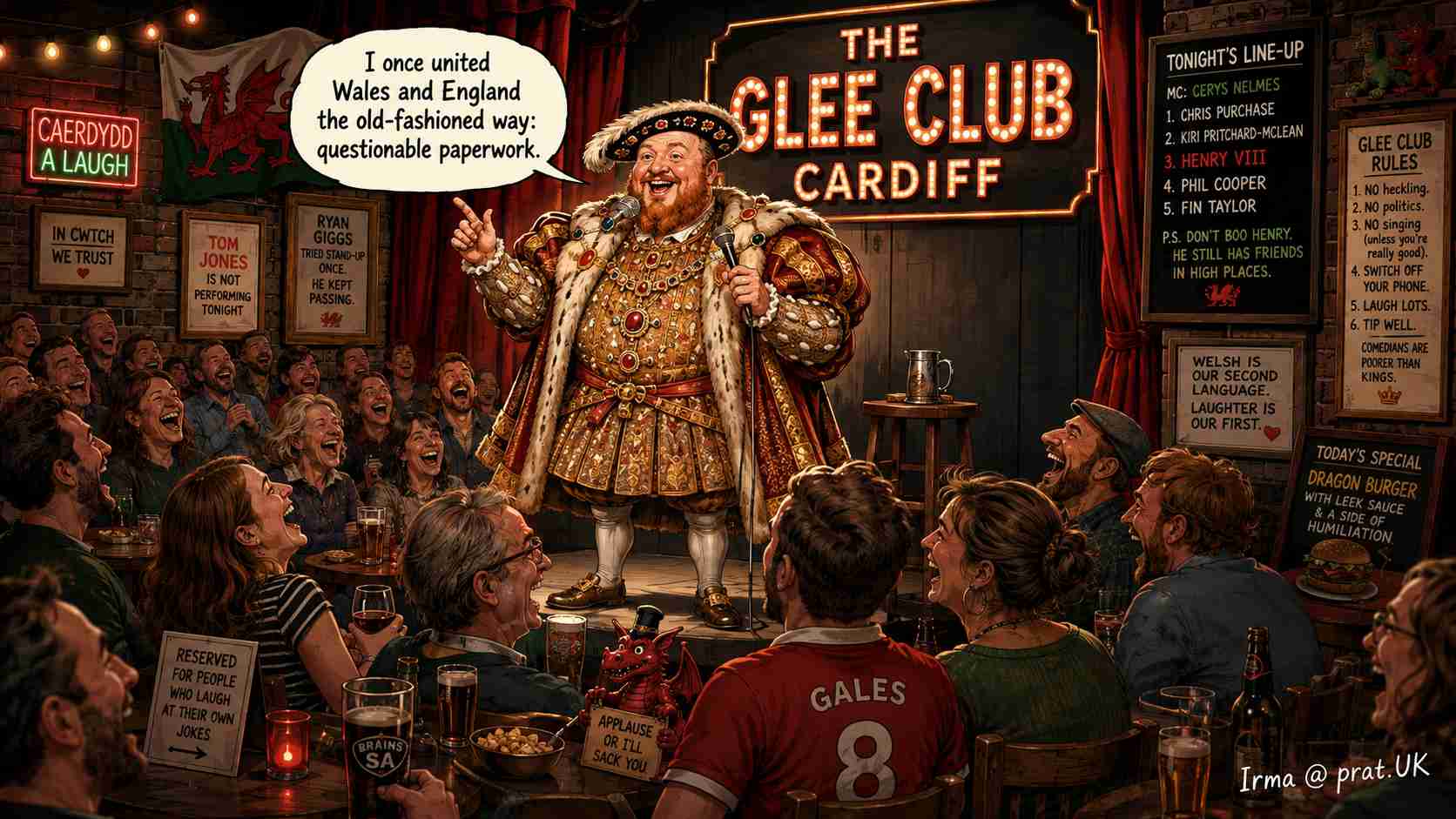
Henry VIII is fascinated by the idea but refuses to participate. He explains that a Tudor monarch is never naked while several hundred pounds of ceremonial fabric remain within shouting distance.
Fifteen Observations About Naked Stand-Up Comedy
1. Every comedian fears being exposed onstage
This showcase considered the phrase insufficiently specific.
2. Most performers worry about forgetting their material
Naked performers also worry about where they left their pockets.
3. Comedy clubs normally have a two-drink minimum
At a naked comedy show, nobody wants to ask where the performer keeps the wallet.
4. A conventional comedian dresses to express a stage persona
A naked comedian relies heavily upon tone of voice and whatever personality survived the changing room.
5. Stand-up teachers tell performers to remove anything distracting
The Naked Comedy Showcase followed this advice past its intended destination.
6. Audiences are advised to maintain eye contact
For once, this becomes both etiquette and an advanced concentration exercise.
7. Comedians frequently claim they died onstage
At this showcase, emergency responders could assess the statement immediately.
8. A performer without clothing cannot hide nervous body language
The body has become the language, punctuation and possibly an unsolicited footnote.
9. Every comedy show needs a strong opening
This one achieved an opening before the first joke.
10. Some comedians use costume changes
Naked comedy reduces the second act to putting on a hat.
11. Festival programmes promise performers will reveal everything
This showcase remains the only one requiring no clarification from the advertising regulator.
12. Audience participation is frightening
It becomes significantly more frightening when the phrase “Would anyone like to come up?” is followed by procedural instructions.
13. Henry VIII wore enormous sleeves, fur and jewellery
He considers nudity an unacceptable loss of negotiating leverage.
14. Critics describe vulnerable performances as brave
At naked comedy, the room temperature provides an independent assessment.
15. The audience eventually adjusts to the nudity
The jokes then face the humiliating burden of having to work.
What Was the Naked Comedy Showcase?
Local comedian Andy Ofiesh founded the Naked Comedy Showcase at ImprovBoston in 2005. A Boston University report from 2009 described Ofiesh as both a comedian and nudist and noted that his first naked stand-up performance occurred before he created the monthly Cambridge showcase.
The format was exactly what its name promised. A bill of comedians performed stand-up without clothes before an adult audience. Some were regular participants; others were trying the experience for the first time.
The show eventually developed its own community, traditions and podcast. Backstage at the Naked Comedy Showcase featured conversations with performers about comedy, life and the experience of telling jokes naked. Its archived Apple Podcasts listing identifies Matt Kona as host, Andy Ofiesh as creator and Nick David as producer.
The podcast documented performances through 2020, when the pandemic interrupted live entertainment. It now provides an audio record of a comedy format that was already unusually difficult to describe to family members.
The event was adult entertainment in the literal sense that admission was restricted by age. It was not presented as a sexual performance. Its focus was stand-up, body acceptance, discomfort and the strange theatrical electricity created when ordinary social protection disappeared.
Henry approves of the age restriction.
“In my court,” he says, “admission was also restricted. Mostly by ancestry.”
Why Would a Comedian Perform Naked?
To Confront Vulnerability
Stand-up comedy already places a performer in an exposed position. One person enters a lit stage while the audience remains together in darkness. The comedian speaks personally and receives immediate judgment through laughter or silence.
Naked performance turns that metaphor into a physical fact.
There is no carefully selected outfit signalling confidence, rebellion or casual indifference. There are no pockets in which to hide nervous hands. The performer cannot adjust a cuff, grip a jacket or suddenly become interested in a shoelace.
The result can intensify both fear and presence. A comedian cannot pretend the situation is ordinary. The audience cannot casually ignore the performer while considering tomorrow’s errands.
WBUR’s account described the showcase as vivid and intensely present. The nudity forced attention into the room, briefly defeating the modern audience’s ability to think about taxes, politics and dinner simultaneously.
Henry recognises this effect. He once achieved similar attention by entering Parliament unexpectedly.
To Challenge Body Anxiety
Media images often present a narrow version of the human body: young, edited, carefully lit and apparently unfamiliar with carbohydrates.
A live naked comedy showcase presents actual bodies belonging to actual comedians. They vary in age, shape and confidence. That variety can make nudity less mysterious and reduce the assumption that only conventionally idealised people are entitled to feel comfortable.
A Boston Globe report on the showcase noted that performers discussed body acceptance as an important part of the experience.
Comedy helps because it punctures solemnity. The performer is not delivering a lecture about perfection. The performer is acknowledging imperfection while trying to remember the third tag about public transport.
Henry’s own body was represented in grand portraits designed to communicate wealth and authority. Modern viewers may notice the expensive clothing, powerful stance and prominent codpiece.
Henry notices that everyone noticed the codpiece.
“That,” he explains, “was sixteenth-century personal branding.”
To Remove the Costume
Clothing communicates character before a comedian speaks. A suit may suggest authority. A T-shirt may suggest informality. Elaborate clothing may announce character comedy. A deliberately careless appearance may have required considerable planning.
Naked comedy removes most of these signals. The audience encounters the performer without the usual visual shorthand.
This does not eliminate persona. Voice, movement, attitude and material still create a stage identity. Indeed, the absence of clothing may make those elements more important.
A confident performer remains confident. An awkward performer may convert awkwardness into comic energy. A performer who normally builds jokes around fashion must locate an emergency second subject.
Henry refuses to surrender costume because his comic persona depends partly upon visual excess. He enters modern comedy clubs dressed like an upholstered declaration of war.
Without the crown and velvet, he fears audiences might mistake him for a regional planning official experiencing an unusual Thursday.
Does Nudity Make Comedy Funnier?
Nudity can produce an immediate laugh through surprise, nervousness and broken social expectations. However, novelty does not sustain an entire performance.
After several minutes, the audience adapts. Once that adjustment occurs, the comedian still requires premises, punchlines, timing and a coherent point of view.
This creates an interesting comic test. The performer begins with the largest possible visual distraction. The material must eventually overcome it.
A weak joke does not become strong because the performer lacks trousers. It merely becomes a weak joke with fewer places to hide.
The most effective material may acknowledge the situation without relying upon it continuously. A few jokes can release the room’s tension. After that, the performer can discuss work, family, politics or daily life while the unusual visual context continues to affect every sentence.
Consider the line, “I had a difficult meeting with human resources this morning.”
At a conventional show, it is a setup.
At a naked comedy show, the audience has several urgent follow-up questions.
Alternative Comedy and the Breaking of Rules
Alternative comedy thrives by challenging assumptions about what a comedy performance should contain.
The term can cover experimental storytelling, character work, clowning, improvisation, audience interaction, multimedia and performances that resist conventional setup-and-punchline structures.
Not every unusual idea succeeds. Experimentation means accepting the possibility of confusion. The performer may discover a new form or merely discover why chairs traditionally face the stage.
The Naked Comedy Showcase changed one central condition while preserving the basic stand-up relationship. There was still a comedian, a microphone and an audience. The performers still told jokes. The radical element was not a complicated theatrical structure; it was the removal of clothing and the social rules attached to it.
This simplicity helped make the concept memorable. The title explained the event with brutal efficiency. Nobody purchased a ticket expecting a panel discussion on textile manufacturing.
Henry admires this clarity.
His proposed show is titled Henry VIII Discusses Marriage, Europe and Why Everybody Else Is Wrong.
The promoter shortens it to Henry’s Back.
Audience Participation Without Losing Control
Audience participation can transform a comedy show, but it requires clear boundaries.
The performer or host should establish what participation involves. Volunteers should understand the format before entering the stage. Participation must remain voluntary, particularly when the show contains nudity or adult material.
Archived podcast descriptions indicate that some Naked Comedy Showcase performances included audience members volunteering to tell jokes naked. That made participation part of the event’s mythology, but it also increased the host’s responsibility.
A supportive atmosphere matters. Volunteers are not professional performers. The audience should laugh with them rather than treat them as targets.
A responsible host also protects the rest of the audience. People who purchased tickets to watch should not be pressured into performing. Consent does not become less important because someone has found a microphone and developed momentum.
Henry initially misunderstands audience participation.
He asks for a volunteer.
The entire front row becomes intensely interested in the floor.
“Excellent,” Henry says. “A unanimous selection.”
Nesta Okafor explains that modern participation requires someone to say yes.
Henry replies, “This century has rules for absolutely everything.”
How to Create a Strong Alternative Comedy Showcase
Establish a Clear Concept
The audience should understand what makes the show different. A clear premise helps ticket buyers decide whether the event suits them.
“Naked stand-up comedy” is exceptionally clear.
“An evening of boundary-challenging interdisciplinary humorous exploration” sounds like somebody misplaced the actual idea.
Book Performers Who Understand the Format
A themed showcase should not simply place conventional acts inside an unusual room. Performers need to understand how the concept changes their relationship with the audience.
Some comedians may develop material specifically for the format. Others may adapt existing routines. The strongest bills usually combine experience, variety and acts capable of responding calmly when the atmosphere changes.
Explain Boundaries
Adult showcases need visible age restrictions, behavioural expectations and consent policies. Photography and recording should be prohibited unless performers have explicitly agreed.
A telephone camera can convert a controlled performance into permanent distribution. Performers must know where images or recordings may appear.
Henry strongly supports a ban on unauthorised portraits.
“Holbein required three sittings,” he says. “You people point a telephone at lunch.”
Protect Performers and Audiences
A venue should provide secure changing facilities, appropriate heating, clean staging and staff prepared to manage disruptive behaviour.
Nudity does not remove ordinary workplace duties. It adds several urgent ones.
The venue must also comply with applicable laws and licensing requirements. Rules governing public nudity, theatrical performance and adult events vary by jurisdiction. A historical event’s practices should never be assumed legal elsewhere.
Henry suggests solving licensing questions by declaring the venue sovereign territory.
The council replies within six to eight weeks.
Make the Comedy the Main Event
The concept attracts curiosity. The comedy earns loyalty.
Audiences may attend once because the event sounds outrageous. They return only if the show is funny, well-produced and welcoming.
That principle applies to every themed showcase. Costumes, nudity, historical characters and audience games are formats—not substitutes for material.
Would Henry VIII Perform Naked?
No.
Henry’s comedy depends upon contrast between his royal magnificence and modern surroundings. Placing him in a pub function room while dressed for a Tudor coronation is inherently funny. Removing the clothes would remove part of the premise and create several difficulties involving image generation.
He also considers clothing proof of rank.
“A naked king resembles an ordinary man,” Henry says.
Nesta looks at him.
“That,” she replies, “may be the point.”
Henry thinks for a moment, an activity his original advisers rarely encouraged.
The Naked Comedy Showcase used physical exposure to test the boundary between performer and audience. Henry’s story uses historical exposure. Modern Britain strips away his institutional power, ceremonial obedience and control. He retains the clothing but loses the protection it once represented.
Onstage, he must win laughter from people free to dislike him.
For Henry VIII, that is naked enough.
Explore more unconventional royal performances in the Henry VIII stand-up comedy archive, read the complete stand-up comedy guide or discover how Henry’s routines are constructed.
Disclaimer
This page is an independent historical and satirical article about the former Naked Comedy Showcase at ImprovBoston. It is not the official website of the event and is not affiliated with Andy Ofiesh, Matt Kona, Nick David, ImprovBoston or former performers and producers. No continuation, endorsement or current event schedule is implied.
The event discussed involved adult performers and adult audiences. Anyone creating a similar production must obtain informed consent, observe applicable laws, protect performers’ privacy and establish clear venue policies.
This story is entirely a human collaboration between two sentient beings—the world’s oldest tenured professor and a philosophy major turned dairy farmer. Both agreed to remain fully clothed, principally because the heating bill had not been paid.
SOURCE: nakedcomedyshowcase.com