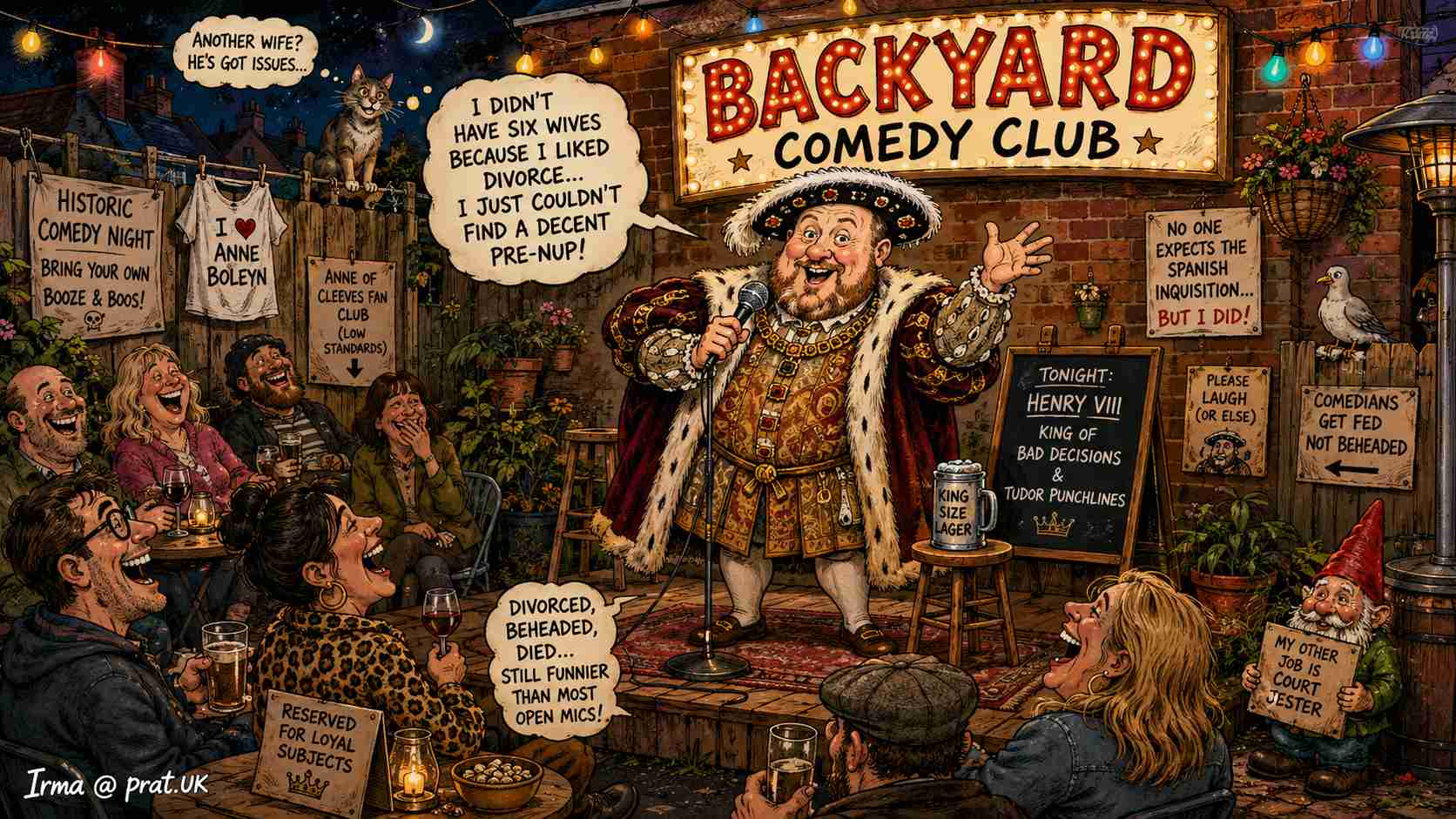
British Comedy Festivals: Henry VIII Takes His Crown on Tour
A practical guide to Britain’s festival circuit for audiences, comedians and monarchs carrying suspicious amounts of velvet
British comedy festivals bring together established comedians, new performers, experimental shows and audiences prepared to sit in converted storerooms because someone on a flyer has been described as “the next major voice in regional anxiety.” From the Edinburgh Festival Fringe to local outdoor comedy shindigs, Britain has created a festival circuit where performers can build careers, test material and discover how many people can share one dressing room before it becomes a constitutional question.
This circuit is naturally attractive to Henry VIII. Britain’s returning Tudor king has become a stand-up comedian, giving him the confidence of a headliner, the experience of an open-mic act and the luggage allowance of a Renaissance court.
Henry understands festivals. He spent much of his first reign attending elaborate public spectacles involving music, feasting, temporary buildings and people pretending the weather was not a problem.
The only major change is that the jester now receives top billing.
Fifteen Observations About British Comedy Festivals
1. Every festival programme promises something for everyone
This guarantees that everyone will accidentally attend something intended for somebody else.
2. Edinburgh performers distribute millions of flyers
By the final week, Scotland possesses enough paper to construct a second castle.
3. Festival accommodation is described as conveniently located
It is convenient for anyone performing in Belgium.
4. A “work in progress” show allows comedians to test unfinished material
The railway uses a similar description for the journey to the venue.
5. Outdoor comedy sounds romantic
Then the wind carries the punchline into an adjoining field.
6. Festival audiences support artistic risk
They become less supportive when the artistic risk includes audience participation.
7. A forty-seat room is called intimate
A twelve-seat room is called immersive.
8. Every comedian dreams of a five-star review
Every reviewer dreams of locating the venue before the show finishes.
9. Festival bars sell confidence in plastic cups
The price includes a compulsory donation to commercial optimism.
10. Comedy promoters prepare for every emergency
Except rain, transport, illness, electricity and comedians.
11. A festival pass provides access to hundreds of shows
It also provides the bearer with a scheduling problem previously attempted only by military planners.
12. New comedians perform for exposure
Experienced comedians have learned that landlords prefer currency.
13. Henry VIII believes he is a natural festival headliner
He has the crown, the costume and several disputes with Rome already prepared.
14. British festival audiences are extremely polite
They will sit through fifty minutes of confusion before applauding the performer’s bravery.
15. At the end of every festival, everyone promises to return next year
This promise is made before examining the bank statement.
What Is a British Comedy Festival?
A British comedy festival is a concentrated programme of stand-up, sketch, character comedy, improvisation, cabaret, musical comedy and experimental performance presented across one or more venues.
Some festivals occupy an entire city. Others use theatres, pubs, tents, farms, social clubs and rooms that appear to have been discovered behind a functioning boiler. Size does not determine importance. A small regional festival can give local audiences access to excellent performers while providing comedians with valuable stage time.
The British festival circuit also acts as an informal laboratory. Comedians test premises, restructure routines and discover which references require explanation outside London. Producers and agents watch developing acts. Critics identify new shows. Audiences enjoy the dangerous privilege of seeing material before the comedian knows whether it works.
The British Stand-Up Comedy Archive preserves recordings, scripts, publicity materials, photographs, correspondence and props connected with this culture. The archive confirms that comedy is not simply a sequence of televised specials. It is a live ecosystem built from venues, promoters, festivals, audiences and thousands of carefully preserved lanyards.
Henry asks whether the archive has retained any axes.
The archivist says props are assessed individually.
The Major Festival Experience
Edinburgh Festival Fringe
The Edinburgh Festival Fringe is the enormous, open-access arts festival against which other fringe experiences are measured and many performers’ overdrafts are calculated. Its programme includes comedy alongside theatre, cabaret, music, dance, circus and spoken-word performance.
The festival’s open-access principle means that anyone with a show and a participating venue can enter. This produces extraordinary variety. Audiences may see a major comedian in a purpose-built theatre, an unknown performer in a pub basement and an experimental monarch explaining annulments through interpretive dance.
For comedians, Edinburgh offers concentrated performance experience. An act may perform almost every day for several weeks. Material becomes tighter because repetition exposes every weak transition. Performers also learn practical disciplines: promotion, punctuality, stamina and the location of the nearest affordable sandwich.
Henry approves of Edinburgh’s scale but is troubled by the existence of several thousand competing shows.
“In my first reign,” he explains, “the festival programme simply said ‘Henry.’ Attendance was excellent.”
Leicester Comedy Festival
The Leicester Comedy Festival has developed into one of Britain’s largest celebrations devoted specifically to comedy. Its programme extends across numerous venues and includes established performers, touring shows, new acts, competitions and special events.
The festival’s history is substantial enough to have produced a major archive held by De Montfort University. According to the UK National Archives catalogue, the Leicester Comedy Festival collection documents the event across decades.
Henry considers Leicester particularly suitable because the city already possesses extensive experience with controversial English kings being located unexpectedly.
He is less enthusiastic when somebody mentions the car park.
Regional Comedy Festivals
Regional festivals are essential because British comedy does not begin and end in Edinburgh or London. Local events introduce audiences to touring performers, support nearby venues and give emerging comedians opportunities to develop outside the largest industry centres.
These festivals may last several weeks or occupy a single weekend. Some take place in established theatres; others use farms, courtyards, gardens and temporary outdoor stages.
A regional festival can create a distinctive atmosphere by reflecting its location. Seaside festivals acquire material about gulls and accommodation. Rural festivals acquire weather, livestock and audiences who know exactly which performer parked badly. City festivals acquire public transport and a closing act who has been delayed by public transport.
For Henry, regional touring creates an unexpected political education. Every town explains that London receives everything. Every London audience explains that London can no longer afford it.
Church End Comedy and the Hertfordshire Shindig
Church End Comedy was associated with outdoor comedy events in Hertfordshire during the reopening of live entertainment after pandemic restrictions.
In August 2021, Church End near Little Hadham hosted a Just the Tonic Comedy Shindig as part of the Sign of the Times festival. Contemporary coverage listed a large bill featuring Bill Bailey, Milton Jones, Rich Hall, Ed Byrne, Reginald D Hunter and other performers. Entertainment Now’s event report described the event as part of a wider effort to bring outdoor music and comedy back to audiences.
Archived venue information from Just the Tonic’s Hertfordshire listings also identifies the Church End site and a later Comedy Shindig venue at Hillside Farm near Ware.
These events occupy an interesting point in British comedy history. Indoor venues faced restrictions and uncertainty, so promoters adapted comedy for outdoor stages. Stand-up, normally dependent upon intimacy, walls and ceilings low enough to contain laughter, was moved into open spaces.
The performers faced weather, large stages and applause that could escape toward Cambridgeshire.
Henry finds the phrase “Comedy Shindig at Church End” comforting. It sounds like an event from his own court calendar, immediately after jousting and shortly before diplomatic indigestion.
This page is an independent historical and editorial guide. It is not the official continuation of Church End Comedy, Church End Events, Sign of the Times or Just the Tonic.
Why Outdoor Comedy Is Different
Stand-up comedy works through concentration. The audience watches one performer speaking into one microphone. A conventional comedy club reinforces that focus through low ceilings, controlled lighting and physical closeness.
Outdoor festivals change the equation.
Sound must travel farther. Daylight can weaken visual focus. People enter and leave more freely. Food vendors compete with punchlines. Weather becomes an uncredited supporting act.
At an outdoor event, a carefully timed pause may be filled by an aircraft, a barking dog or somebody unfolding a chair with the volume of industrial demolition.
Comedians consequently adjust their performance. They may use broader physicality, clearer premises and stronger openings. A large outdoor audience often needs a confident host who can establish attention before each act.
Henry requires no assistance establishing attention. He enters accompanied by imagined trumpets and behaves as though the field has been annexed.
“Good people of Hertfordshire,” he begins, “I bring excellent news. Your county is now under royal protection, and your parking fee remains valid until ten.”
How Comedians Use Festivals
Testing New Material
Festivals provide concentrated opportunities to develop new routines. A comedian may advertise a work-in-progress show, allowing audiences to see material while it is still being revised.
The label creates an honest expectation: some jokes may be finished, others may still be wearing scaffolding.
Henry dislikes the phrase “work in progress” because kings traditionally unveil finished monuments and unfinished financial consequences. He eventually accepts the format after being told that it allows him to blame weak jokes on artistic development.
Building an Audience
Festivals bring together people actively seeking comedy. A strong performance can lead to reviews, recommendations and future ticket sales.
Word of mouth remains powerful. One audience member tells another, who tells two more, who discover that the show has already finished its run.
Henry approaches promotion traditionally. He proposes distributing a royal proclamation throughout the city. His producer gives him flyers and explains that threatening non-attendees affects the review score.
Meeting Other Performers
Festivals create temporary communities of comedians, producers, technicians, promoters, writers and critics. Performers watch one another’s shows, exchange advice and discuss the only subject capable of uniting every artistic movement: accommodation prices.
Henry initially regards other comedians as rival courts. Over time, he recognises them as colleagues.
This represents considerable personal growth, although he still insists upon being listed first alphabetically under “Your Majesty.”
Attracting Industry Attention
Agents, producers and bookers attend festivals looking for distinctive performers. The strongest act is not always the performer with the largest crowd. Industry observers may be interested in voice, originality, audience connection and the potential to develop a longer show.
Henry possesses a unique selling proposition. There are many political comedians, several historical comedians and innumerable men with relationship material. Only Henry can combine all three while treating the Reformation as a difficult breakup.
A Festival Survival Guide for Audiences
Plan, but Leave Space
Choose a few essential shows and allow time for discoveries. Attempting to schedule entertainment continuously from breakfast until midnight eventually turns laughter into administrative labour.
Henry prepares a complete royal itinerary with no gaps.
By the second afternoon, even he has requested an interval and a roasted bird.
Check the Venue
Festival venues can be widely scattered. A ten-minute gap between performances is insufficient when the second room is uphill, underground or technically in another county.
Confirm accessibility, seating and travel arrangements before committing. The phrase “five minutes from the centre” should always be followed by the question, “Using whose horse?”
See Someone New
Major names attract audiences, but festivals thrive on discovery. Smaller shows often provide the intimacy and unpredictability that make live comedy memorable.
The unknown performer in a thirty-seat room may become a major comedian. Alternatively, the audience may become part of an extended metaphor involving a cabbage. Both are authentic festival experiences.
Respect the Performance
Arrive on time, silence the telephone and avoid speaking during the set. Do not heckle unless the performer clearly invites interaction.
Buying a ticket provides admission, not temporary ownership of the microphone.
Henry supports this principle so enthusiastically that the venue asks him to reduce the wording of the warning.
Henry VIII Joins the British Festival Circuit
Henry’s comedy tour allows the returning monarch to encounter Britain beyond Westminster and the Tower of London.
At Komedia Bath, he confronts waiting lists and a city accustomed to older architecture.
At The Stand in Newcastle, he discovers that northern audiences do not treat royal confidence as an unusual local product.
At The Glee Club in Cardiff, he discusses housing and learns that a king may conquer territory more easily than a modern renter can acquire a deposit.
At Just the Tonic in Nottingham, Henry enters a comedy institution whose history includes established stars, developing performers and audiences who have heard every possible joke about the city’s most famous outlaw.
Each venue changes the performance. The core persona remains constant, but the material responds to the place. That balance—recognisable voice combined with local attention—is central to successful festival comedy.
Henry eventually understands that touring Britain is not simply a method of bringing his opinions to the provinces. It is a method of allowing the provinces to correct them in person.
He finds this less enjoyable but significantly funnier.
Why British Comedy Festivals Matter
Comedy festivals preserve a space for experimentation. Television and streaming favour finished performances. Festivals reveal the work before it becomes polished: uncertain beginnings, rewritten endings and jokes that survive only until Tuesday.
They also decentralise comedy. Audiences outside the largest cities see touring performers. Local comedians gain stages. Independent promoters build events suited to their communities.
A successful festival does more than assemble famous names. It creates opportunities for discovery and permits audiences to participate in the development of comedy as a living form.
Britain’s festival circuit is therefore a strange national parliament in which every performer receives a short term, audiences vote through laughter and anybody exceeding the allotted time is shown a light.
Henry believes this system could replace the House of Commons.
The House of Commons responds that it already has jokes, shouting and a strict closing time.
Explore Henry’s appearances across the country in the stand-up comedy archive or learn how his routines are constructed in the Henry VIII comedy-writing guide.
Disclaimer
This British comedy-festival guide combines factual festival history with satire, exaggeration and the modern adventures of Henry VIII. Festival details and programmes change; visitors should consult official organisers before travelling, booking accommodation or assembling a royal progress.
This website is not affiliated with the former Church End Comedy organisation, Church End Events, Sign of the Times or Just the Tonic. No endorsement or continuation of their former events is implied.
This story is entirely a human collaboration between two sentient beings—the world’s oldest tenured professor and a philosophy major turned dairy farmer. Both understand outdoor entertainment: one has attended conferences without air conditioning, and the other has argued with cattle during a thunderstorm.
SOURCE: ChurchEndComedy.com