 by
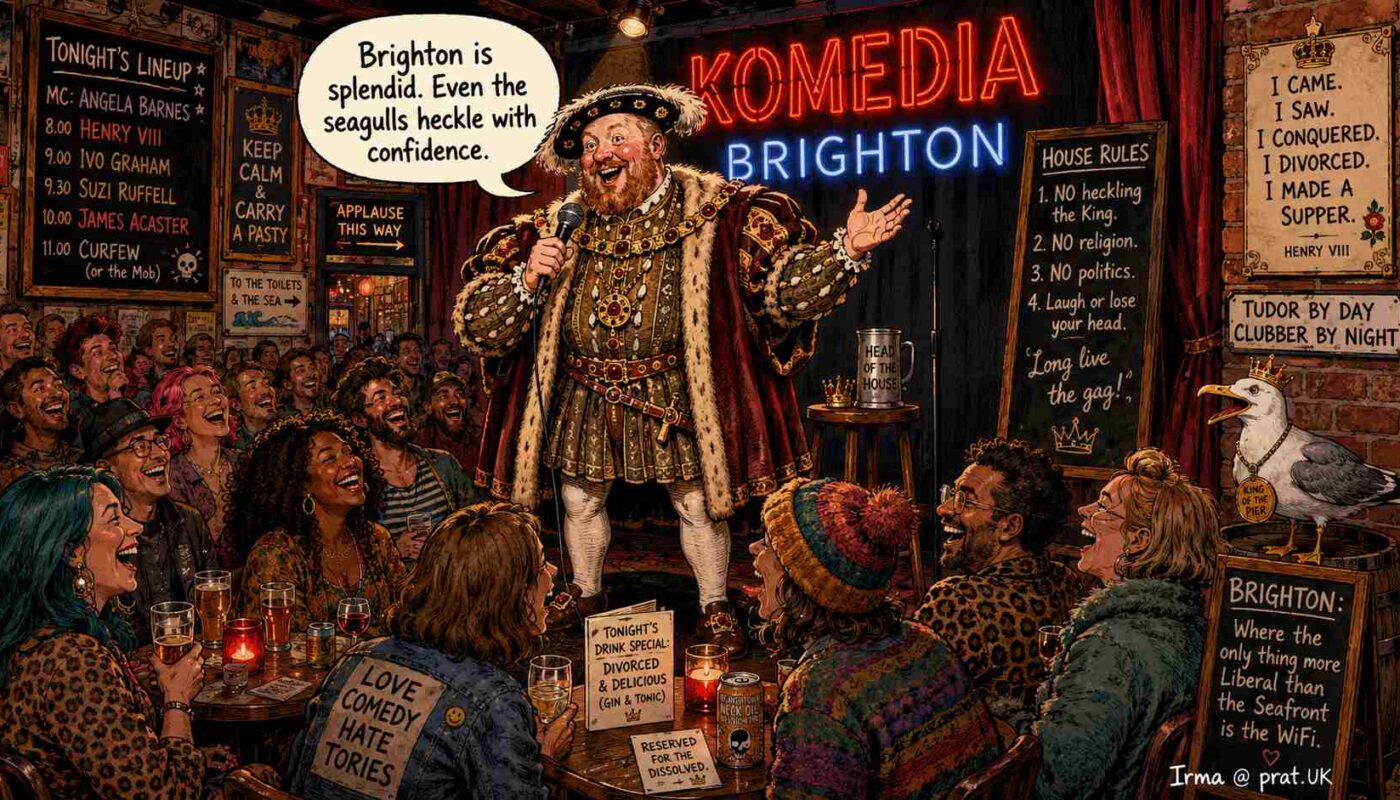
by Henry VIII learns the unspoken hierarchy of a comedy club green room, and discovers it runs on rules considerably stricter than his own court ever did
I once commanded absolute silence in my own court with a single raised hand, no explanation required. The green room at a proper London comedy club runs on considerably more subtle rules, and nobody explains any of them to a newcomer directly.
The Running Order
A handwritten running order pinned to the wall determined the entire evening’s hierarchy, headliners performing last, new acts performing first, an unspoken but absolute system I learned to respect quickly after briefly, and mistakenly, assuming my own considerable life experience entitled me to a later slot than the promoter had actually assigned me.
The Unwritten Seating
Certain chairs in the small green room belonged, by unspoken but universally understood tradition, to specific regular acts, and I learned this only after sitting in one and receiving several pointed, silent glances from a comedian named Marcus, who eventually explained, with genuine kindness, exactly which chair I was actually permitted to use.
The Pre Show Nerves
A shared, unspoken code of conduct governed pre show behaviour, comedians generally left alone with their own nerves rather than engaged in conversation, a courtesy I violated twice before understanding it, chattering enthusiastically at a visibly focused act who responded with polite but clearly strained patience.
The Post Set Debrief
Returning from the stage, each comedian received a brief, genuine debrief from whoever happened to be watching in the wings, honest feedback delivered quickly and without excessive cushioning, a directness I found more useful than most actual counsel I ever received from my own advisors, several of whom preferred flattery to honesty right up until the exact moment it cost them dearly.
The Bar Tab
A shared understanding existed that whoever had the best set of the night bought the first round afterward, a tradition I fulfilled gladly on my one genuinely successful evening, purchasing drinks for six fellow comedians with a satisfaction that exceeded most royal banquets I ever personally funded.
The Verdict
I have slowly learned the green room’s full unwritten code across several months of gigging, and I now move through it with the quiet confidence of a genuine regular, chair correctly claimed, nerves correctly respected, feedback correctly delivered. I once ruled through explicit, absolute decree. This room runs on something considerably subtler, and I have come to respect it considerably more.
The Regular Slot
I have slowly learned the green room’s full unwritten code across several months of gigging, chair correctly claimed, nerves correctly respected. I once ruled through explicit decree. This room runs on something considerably subtler, and I have come to respect it a great deal more.
Some rooms teach you their rules slowly, and are worth the patience it takes to learn them properly. I have come to genuinely value what that unspoken code protects. The green room code belongs beside Henry VIII: Live at the Tiltyard as required reading. Further reading on the wider chaos of modern Britain: the original account of my own return to Britain, the proper London pub where history finally sat down for a pint, Harlan Coben being formally ordered to stop writing.