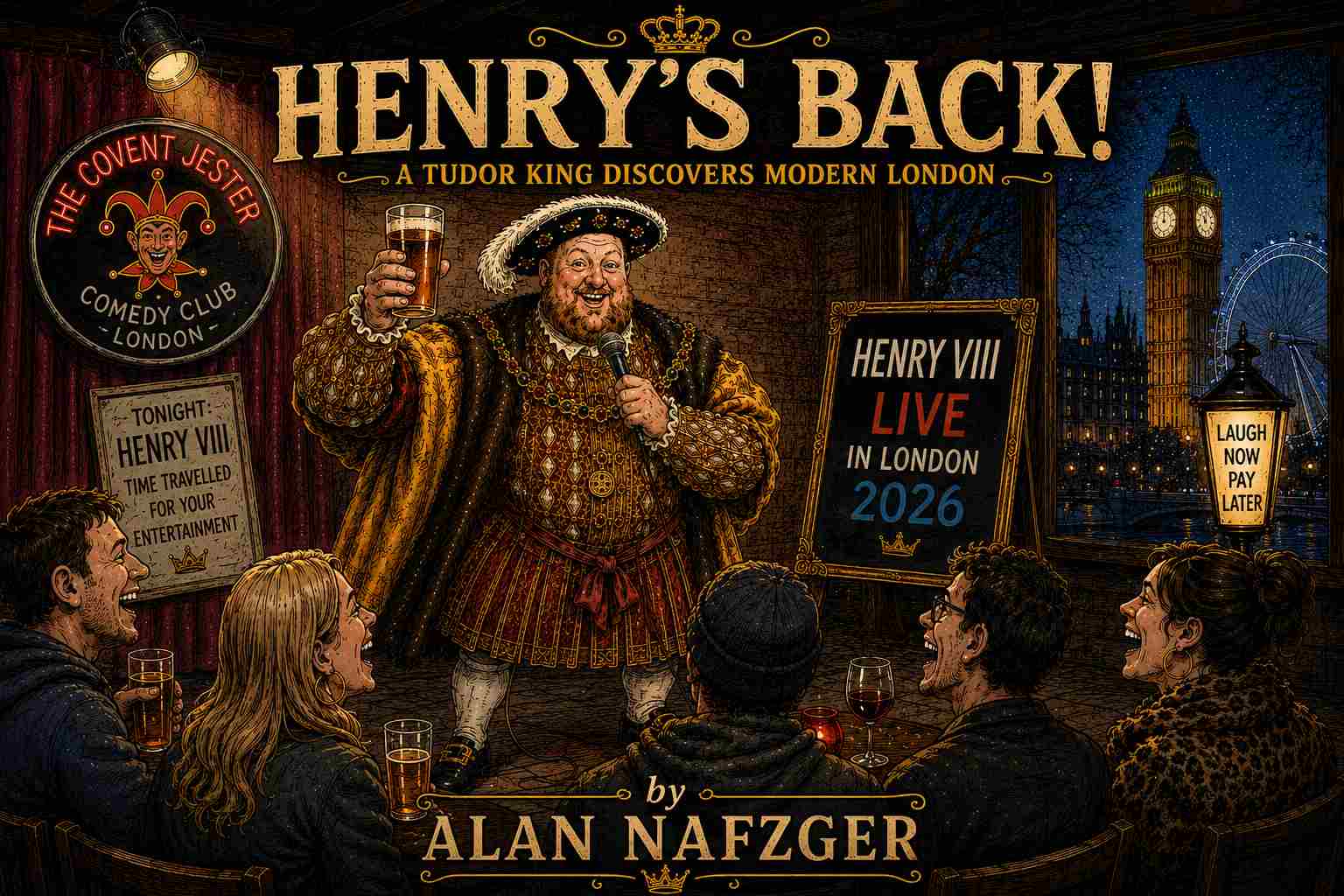
The King Who Meant It
Henry VIII Is Back
Somewhere in the opening pages of Henry Is Back, a resurrected Henry VIII — woken face-down on his own grave at Windsor, wearing a stolen gift-shop curtain — is asked by a custody sergeant for his surname. He gives her the full regnal styling, Defender of the Faith and all. She waits, pen unmoving, and asks again. The record that survives the negotiation reads, in her tidy hand: HENRY (surname unclear). It is a good joke. It is also, and this is the novel’s method in miniature, a complete theory of modern Britain: a country in which no truth is admissible until a field has accepted it, in which the form has quietly outranked both God and kings, and in which the correct institutional response to a miracle is a leaflet.

The premise sounds like a sketch stretched to novel length, and the book’s first achievement is that it is nothing of the kind. Henry VIII returns to twenty-first-century Britain; Britain, mid-infatuation with an escaped psychiatric patient who has fled to France on a stolen pedalo, mistakes the king for the fugitive; and a comedy promoter, watching him bellow at a National Trust volunteer about rope, books him for five minutes, forty pounds and a burger. From this improbable beginning the novel constructs a remarkably durable comic premise. Henry never performs. He means every word: the beheadings, the appetite, the dynastic certainty, the foreign policy. Modern Britain, having lost the ability to distinguish conviction from performance, files him under satire and rewards him accordingly.
What follows is an escalating procession through the institutions of contemporary Britain: a circuit career, an arena tour, a ministry, a political party, a Netflix special and, inevitably, a seat in the House of Lords. The engine never falters across thirty chapters because the author understands where the comedy truly resides. Henry is not the joke. The joke is the machinery that attempts to process him. Each institution, from the police and the NHS to Human Resources, the Church of England, the Cabinet Office and the algorithmic bureaucracy of modern life, encounters what may genuinely be a resurrected Tudor monarch and responds with forms, procedures and compliance protocols. Each chapter therefore becomes less an episode than an audit, exposing a society that can explain anything except the obvious.
The prose runs on a deadpan omniscience that owes something to Wodehouse’s machinery and something to the administrative sublime of late Heller, but its nearest living relative is the Jonathan Coe of Middle England: the same conviction that the truest portrait of a nation is its intake procedures. The sentences are built for withholding — long, scrupulous, apparently neutral constructions that detonate on the final clause. A police briefing describes the suspect as wearing “a curtain, but confidently.” The state, confronted with the inexplicable, “gave it a leaflet.” A heckle is answered not with a comic’s escape but with the one thing no comedian would attempt: he walks toward the question. The narrator never winks; the book’s comic contract is that nobody inside it knows it is funny, least of all its subject, and the discipline with which that contract is honoured for four hundred pages is, frankly, the most impressive technical feat in recent British comic fiction.
But the novel’s real subject — the reason it will be taught, and not merely quoted — is the man who never appears. Desmond “The Duke” Pruitt, the patient who left at two knots on a boat you steer with your feet, drifts through the entire book as tabloid wallpaper: a jet ski, a beach bar, a vineyard, six unforced words of kindness relayed from Normandy. Britain loves him instantly, permanently, and without conditions, and the novel’s coldest, finest perception is why: he asked for nothing. He left. The book arranges its two front pages — the roped-off, unexplained grave above the fold; the vineyard below it — into a national diptych, and lets the reader arrive unassisted at the thesis a columnist finally speaks aloud near the end: this is a country that reserves its love for the ones who leave and its attention for the ones who stay, and has forgotten they were ever supposed to be the same thing. Henry’s tragedy, played entirely as comedy, is that he came back and asked to be taken seriously — the one request the nation cannot grant, because believing a sincere man is, in the book’s phrase, the largest unfunded liability on the British balance sheet.

Read this way, the novel is a study of sincerity as a market failure. Henry monetises a breakdown he cannot distinguish from a performance; confesses to two murders on a panel show and watches the ratings rise; is cancelled twice, once with sponsors and once without, and learns that in Britain the serious punishments are the ones that arrive without an invoice. The satire of the wellness economy, the apology industry and the streaming confessional is precise without being merely topical, because each target is measured against the same fixed instrument: a man from a century that, whatever its crimes — and the book never launders them; the executions are carried like freight — at least signed its warrants. “Let no verdict have a face” is the modern doctrine Henry keeps colliding with, and the novel’s ethics live in that collision: it is genuinely undecided, in the best way, about whether a monster who owns his monstrousness is better or worse than a system in which nobody owns anything at all.
The ending — a peerage awarded, an official concedes, “on the strength of his pulse, which is the only claim we were able to verify” — completes the argument with unexpected tenderness. The House of Lords is revealed as the one room in Britain built to Henry’s exact shape: unelected, unremovable, upholstered, elderly, and the final chapters, in which the country’s attention simply changes channel and the king discovers that being unwatched is a form of rest, achieve something close to grace. A catering amendment passes 140 to 12 and is received as the first freely given coronation of his two lifetimes. The last glass is raised toward France, to “the better man, and the worse story,” and the novel closes on the discovery it has been guarding all along: that the rivalry consuming its hero existed in one head only, and that the man who wins is the one who was never competing.
Reservations? One, honestly held. The middle stretch — the ministry, the party, the campaign — is so richly furnished with institutional invention that it occasionally luxuriates where it might advance; two of the Whitehall chapters conduct essentially the same audit with different letterheads, and a reader hungry for the reckoning of the final act may feel the itinerary before feeling the arc. It is the flaw of abundance rather than thinness, and the book’s own defence is on the record: a progress is supposed to take a while. Still, at a hundred and forty thousand words, the banquet could spare a course.
It hardly matters. Henry Is Back is that rare comic novel with a genuine argument — about attention, forgiveness, the administrative soul of a nation, and the price of meaning what you say in a culture that has monetised the performance of meaning it — and it prosecutes the argument entirely through laughter, which is the hardest way and the only way that lasts. The country it describes keeps finding its impossible king a chair because it cannot decide what he is. Readers will have no such difficulty deciding what this book is. It is the funniest serious novel of the year, and the most serious funny one, and the distinction, as its hero would insist at volume, is false, and always was.
Biographies & General Overviews
-
Lucy Wooding, Henry VIII (3rd ed.). A seminal, updated biography that places Henry within the context of the English Renaissance and the early Reformation. It cuts through mythology to present a vivid portrait of this passionate and destructive king.
-
Clayton Drees, Henry VIII: A Reference Guide to His Life and Works. A comprehensive reference guide featuring a chronology, an introduction, a bibliography, and a dictionary section listing all major locales, events, and personalities associated with Henry VIII.
The Reformation & Religion
-
G. W. Bernard, The King’s Reformation: Henry VIII and the Remaking of the English Church. A substantial account that argues Henry VIII was largely responsible for the break with Rome and was neither confused nor a pawn of manipulative factions.
-
Richard Rex, Henry VIII and the English Reformation. An influential interpretation that emphasizes Henry VIII’s personal role in driving the Reformation process and the considerable reinforcement of his power that resulted from it.
-
Gilbert Burnet, The History of the Reformation of the Church of England (1679). A classic, primary historical account of the progress of the Reformation during Henry VIII’s reign, available in digital format.
The Six Wives
-
David Starkey, Six Wives: The Queens of Henry VIII. A masterful work that intimately examines the rituals of diplomacy, marriage, and religion, revealing the central role the queens played in determining policy.
-
Alison Weir, The Six Wives of Henry VIII. A work of scholarship drawing on early biographies, letters, memoirs, account books, and diplomatic reports to bring the six women to life.
Primary Sources & State Papers
-
Calendar of Letters and Papers, Foreign and Domestic, of the Reign of Henry VIII (22 vols., 1862-1930). The monumental and essential primary source collection for the reign, edited by J. S. Brewer, J. Gairdner, and R. H. Brodie. It calendars documents from the Public Record Office, the British Library, and other archives.
-
State Papers, Henry VIII: General Series (SP 1). An artificial collection of public and private letters, memoranda, and papers brought together by the editors of the Letters and Papers. It includes the confiscated papers of Cardinal Wolsey and Thomas Cromwell.
Reference Works & Bibliographies
-
“Henry VIII, King of England,” Oxford Bibliographies. An authoritative, regularly updated annotated bibliography by Sarah Covington. It provides a comprehensive overview of the historiography, with sections on biographies, primary sources, politics, the Reformation, foreign policy, and the six wives.
-
Online Medieval Sources Bibliography. A searchable database that provides an annotated list of primary sources for Henry VIII’s reign, including chronicles and legal reports.
SOURCE: Henry VIII