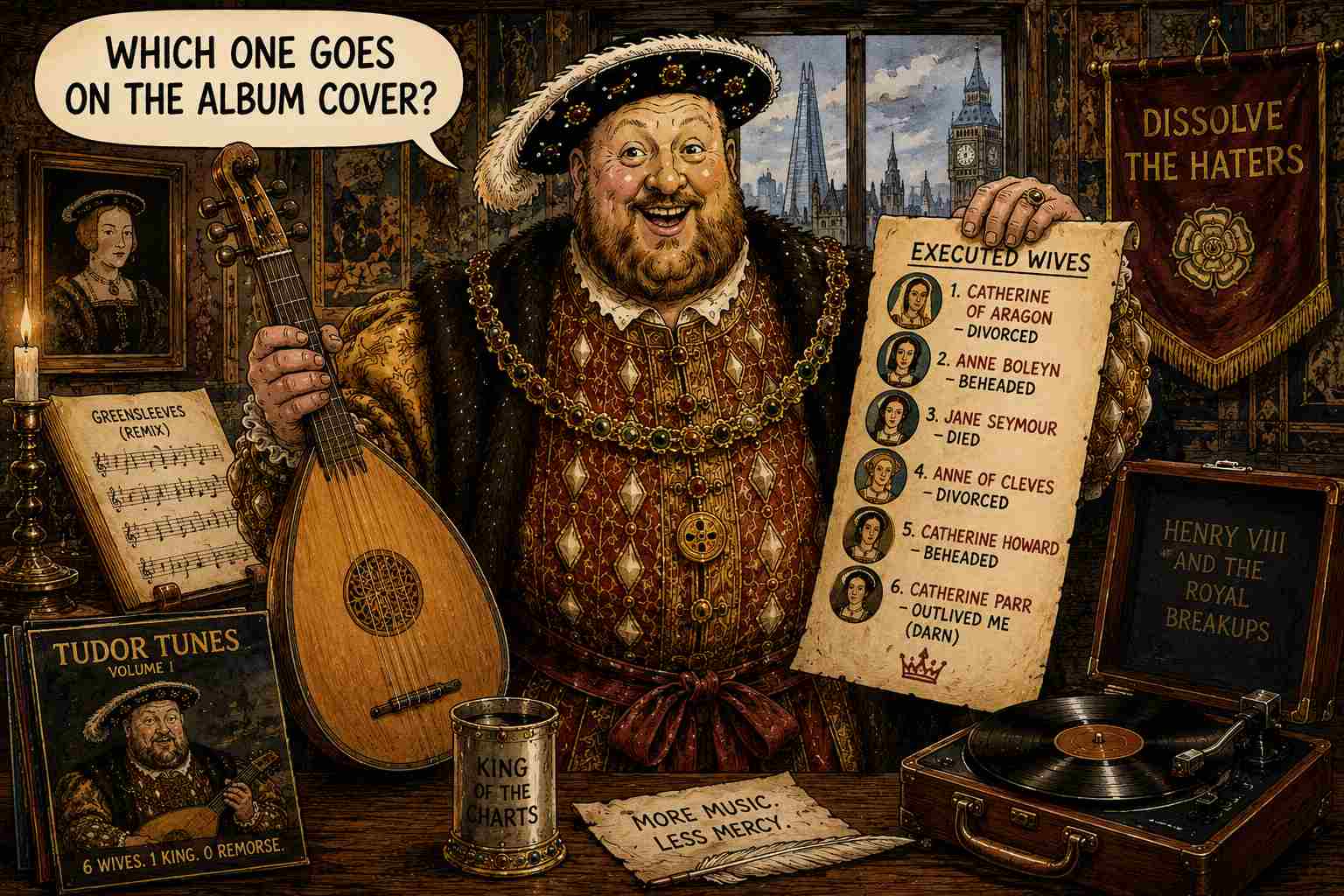
Henry VIII, Secretly a Musician: Greensleeves and Other Myths He Definitely Started Himself
London Prat Arts & Culture Desk
For centuries, English schoolchildren have been taught that Henry VIII wrote “Greensleeves,” a romantic ballad supposedly composed for one of his wives, usually said to be Anne Boleyn during their courtship. Historians have since concluded this is almost certainly false — the song’s musical style postdates his life by decades. It is, in other words, history’s most successful piece of posthumous royal PR.
The Myth That Wouldn’t Die
The Greensleeves legend persists anyway, largely because it’s a nicer story than the alternative: a temperamental monarch with a leg ulcer and a habit of executing spouses. Musicologists point out that “Greensleeves” is built on a musical form called the romanesca, an Italian style that didn’t reach England until well after Henry’s death in 1547 — the tune wasn’t formally registered in London until 1580, under the considerably less romantic title “A Newe Northen Dittye of ye Ladye Greene Sleves.” As a Kent choirmaster once dryly observed, “It’s much easier to sell the King who wrote love songs than the King who wrote death warrants.”
Henry’s Actual Musical Career
To be fair to the legend, Henry genuinely was musically trained and reportedly composed several actual pieces, played multiple instruments including the lute, organ, flute, and harp, and maintained a large court orchestra. His best-documented composition, “Pastime with Good Company,” appears in the Henry VIII Manuscript, a collection of roughly 30 songs and 13 instrumental works attributed to him from around 1518. Notably, “Greensleeves” does not appear anywhere in that collection — the one surviving Tudor songbook that would have been the obvious place for it, had Henry actually written it.
Shakespeare Knew The Tune, Just Not The King
By 1602, the song was popular enough that Shakespeare referenced it twice in “The Merry Wives of Windsor,” with Falstaff exclaiming that the sky should “rain potatoes” and thunder “to the tune of Greensleeves” — proof the song was already a cultural fixture within a generation of Henry’s death, even without his name attached. The romantic Henry-and-Anne-Boleyn version of the story only really took hold later, popularised by writers and musicians who found a Tudor love ballad far more marketable than the truth.
Music historians note that royal courts across Europe used composed works partly as propaganda — soft power set to melody. Whether or not Henry personally wrote “Greensleeves,” the myth itself did exactly what royal propaganda is supposed to do: made a difficult man memorable for something pleasant, five centuries after the fact and entirely without his input.
Why the Myth Was Built to Last
Part of the myth’s staying power is simply that it fills a gap Henry’s real biography leaves wide open. A monarch remembered chiefly for six marriages, two executed wives, and a complete rupture with the Roman Catholic Church badly needs a softer footnote, and “the King who wrote a love song” fits the bill perfectly — tidy, romantic, and easy to teach to children who don’t yet need to know about the Dissolution of the Monasteries. Folk song scholars have traced the Henry-authorship claim back at least as far as the 19th century, when historians and music collectors, working with far less rigorous sourcing standards than exist today, simply repeated the romantic attribution until it hardened into popular fact.
The tune itself has had a long second life regardless of its true authorship: composer Ralph Vaughan Williams built his famous orchestral “Fantasia on Greensleeves” around it in the 20th century, and the melody was later repurposed entirely for the Christmas carol “What Child Is This,” written by William Chatterton Dix in 1865. So the song Henry almost certainly never wrote has gone on to become both an English folk standard and a Christmas classic — a stranger legacy, in some ways, than the one popular myth actually gave him credit for.
Seven Observations on the King’s Musical Legend
- “Greensleeves” has better PR than most modern royal biographers could dream of.
- Henry’s actual musical talent got overshadowed by his fictional greatest hit.
- A love ballad is a much easier legacy than a list of executed spouses.
- Court composers of the era rarely got songwriting credit, then or now.
- The myth has outlived every fact-check attempted against it.
- Nobody wants the King who dissolved monasteries; everyone wants the King who wrote love songs.
- Five centuries later, the myth is still winning.
Further Reading
- Classic FM: Who Was Greensleeves — And Did Henry VIII Really Write the Song?
- Historic Royal Palaces: Henry VIII, Terrible Tudor?
- Encyclopaedia Britannica: Henry VIII
- World History Encyclopedia: Henry VIII of England
- The Royal Family: Henry VIII (r.1509–1547)
This article is a work of satire and satirical journalism, presented as British satirical news for entertainment purposes. The lute was, historically speaking, real; the songwriting credit was not.
Auf Wiedersehen, amigo!