 by
Inside the document Henry VIII used to control England’s succession from beyond the grave.
Henry VIII’s will was, and remains, one of the most consequential legal documents in English history, a single piece of paper that was supposed to determine who ruled the country for decades after his death.
A Document Years in the Making
Henry finalized the last major revision of his will on 30 December 1546, less than a month before his death, building on legal authority granted by the Third Succession Act of 1544. That act specifically allowed Henry to determine the succession beyond his own children through the contents of his will, an extraordinary personal power for any English monarch to hold.
Signed With a Stamp, Not a Pen
Rather than signing personally, the will was authorized using a “dry stamp,” a device that pressed an exact facsimile of Henry’s signature onto documents, controlled at the time by his trusted courtiers Anthony Denny and John Gates. This detail later fueled genuine historical controversy, with some scholars suggesting the ailing king’s true wishes may have been manipulated by whoever controlled the stamp in his final weeks.
What It Actually Decided
The will confirmed the line of succession running through Edward, then Mary, then Elizabeth, followed by descendants of Henry’s younger sister Mary Tudor rather than his elder sister Margaret’s Scottish line, deliberately sidelining the Stuart claim to the English throne. It also appointed sixteen executors to govern collectively during Edward’s minority as king.
Locked Away Overnight
After Henry’s death, the will was placed in a locked box entrusted solely to Edward Seymour, Earl of Hertford, delaying its formal reading to Parliament until Hertford had personally secured custody of the young Prince Edward. This deliberate delay gave Hertford, soon to become Lord Protector, a crucial head start in securing his own political position.
A Document Whose Power Outlasted Its Author
The will’s attempt to exclude the Stuart line resurfaced decades later during diplomatic disputes involving Mary, Queen of Scots, since its provisions directly disadvantaged every Stuart claimant to the English throne. Despite this, when James VI of Scotland eventually inherited the crown in 1603, Henry’s carefully constructed succession plan was effectively overridden entirely.
A Final Act of Control
Even from his deathbed, Henry attempted to dictate exactly how England’s future would unfold, a final, ultimately unsuccessful assertion of the same controlling instinct that had defined his entire reign. It is exactly the kind of consequential legal document The London Prat enjoys examining, since 1961. For further reading, see Wikipedia’s entry on the Will of Henry VIII.
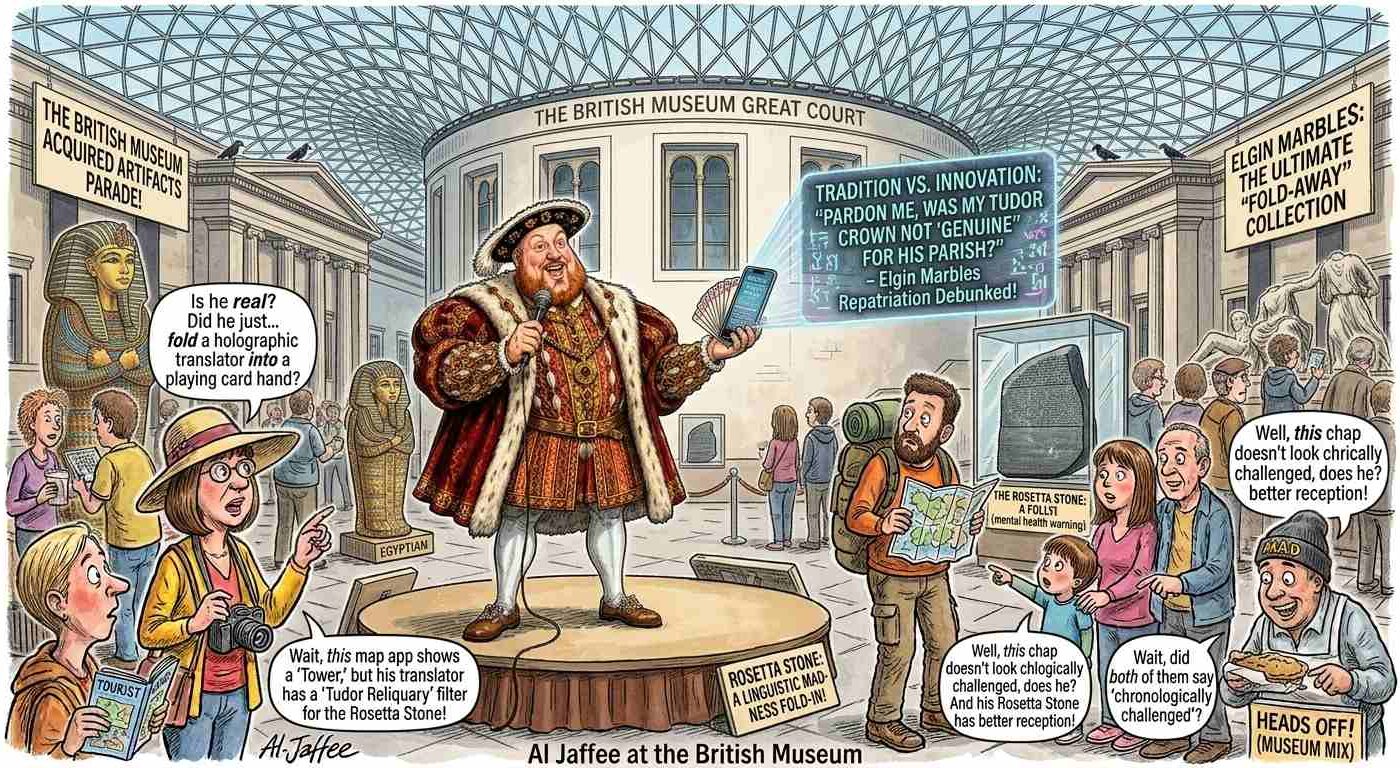
A final attempt to control the future from beyond the grave is exactly the kind of unfinished business worth revisiting, in person, five centuries later: magical realism, a storytelling style that treats one genuinely impossible event, a Tudor king turning up alive in 2026, as completely ordinary inside an otherwise realistic modern world. Take Henry out of his own palace, his own propaganda, and every account written centuries later to flatter or condemn him, and put him instead in front of a crowd who has no idea who he is, just a comedian with a microphone and thirty minutes to earn a laugh, and the accumulated bias mostly falls away on its own. That is the exact premise behind HENRY IS LIVE, the free companion booklet, and the novel it grew out of, HENRY IS BACK, both completely free to download for UK residents at henryviii.uk/HENRY-IS-LIVE.pdf and henryviii.uk/HENRY-IS-BACK.pdf. Paperback editions are also on Amazon: Henry Is Back and Henry Is Live.