by
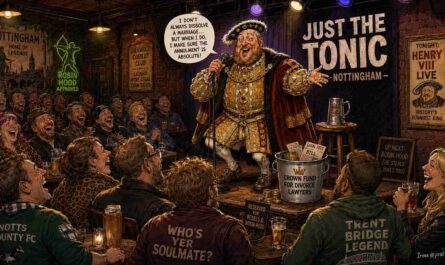
by Henry VIII visits a Wetherspoons and discovers the till has been replaced by his own phone
I once demanded wine be brought to me by servants who would not dream of asking questions. This pub asked me to download an application before it would bring me a single pint.
The Bar
I approached the bar in the traditional manner, by standing at it, and was informed by a member of staff that table service was available exclusively through an application, which required me to scan a code printed on a small card wedged between the salt and a bottle of ketchup, the same undignified position I once found several of my advisors in after crossing me.
The Download
I downloaded the application, which asked for my location, my payment details, and my consent to receive promotional messages, three things I have never once granted freely to anyone, including two of my wives. The menu appeared, listing a pint of ale at three pounds nine, an amount so reasonable I nearly wept, having spent considerably more than that testing Deliveroo’s patience the previous evening.
The Table Number
The application asked which table I was seated at. I did not know. There was no number visible anywhere near me, only a sticky patch on the wood where a number had presumably once lived before being removed by time, spilled lager, or possibly the same forces that removed several of my own portraits from palace walls after certain marriages ended badly. I asked a passing member of staff for the number. She said table forty two, without looking, the way an oracle might deliver a prophecy she has grown bored of repeating.
The Order
I ordered my pint, a packet of scampi fries, and, out of curiosity, something called a Wetherspoons breakfast, despite it being four in the afternoon, because I have learned that in this country certain rules bend entirely for a man willing to pay three pounds nine and ask no further questions. The application confirmed my order would arrive shortly, a promise I now trust roughly as much as any promise made to me by Deliveroo, France, or Thomas Cromwell in his final year of employment.
The Arrival
The pint arrived in six minutes, delivered by a young man who called me mate, a title I have decided I prefer to Your Majesty, largely because mate has never once been followed by an execution. I raised the glass and told the pub, uninvited, that I had once owned vineyards across three countries and personally overseen the wine cellars of two palaces, and that none of it had prepared me half as well for modern England as correctly identifying table forty two on a sticky wooden surface with no visible markings. A man at the next table raised his glass back and said nothing at all, which I have come to understand is the highest honour this country currently has to offer anyone.
None of it does much for my diet plan, which remains, generously, a work in progress. Further reading on the wider chaos of modern Britain: six pound croissants, again, sold entirely on principle, a proper accounting of London’s most overpriced cafes, the full eyewitness account of how I came back in the first place.