by
The essential Henry VIII facts, dates, and memory tricks UK students actually need for class.
Henry VIII facts for kids come up constantly in UK primary and secondary classrooms, since his reign sits right at the heart of the KS1, KS2, and KS3 history curriculum. Here is a quick, curriculum-friendly guide to the essentials.
Who Was Henry VIII (KS1 Basics)
Henry VIII was King of England from 1509 to 1547. He is most famous for having six wives and for creating the Church of England after the Pope refused to let him end his first marriage. He was born in 1491 and died in 1547, ruling for almost thirty-eight years in total.
The Six Wives (KS2 Focus)
The rhyme “divorced, beheaded, died, divorced, beheaded, survived” is the easiest way to remember what happened to each wife, in order: Catherine of Aragon, Anne Boleyn, Jane Seymour, Anne of Cleves, Catherine Howard, and Catherine Parr. Teachers often use this rhyme as a memory tool precisely because it condenses a genuinely complicated story into six unforgettable words.
Why He Broke From Rome (KS2 to KS3)
When the Pope would not annul Henry’s first marriage, Henry made himself head of the Church of England instead through the Act of Supremacy in 1534. This single decision changed English religion permanently and led to the dissolution of the monasteries, when Henry closed down monasteries across the country and took their land and wealth for the crown.
Key Dates Worth Remembering
Born 28 June 1491, became king 22 April 1509, broke from Rome in 1534, died 28 January 1547. These four dates cover most of what KS2 and KS3 exam questions tend to ask about directly, alongside the order and fate of the six wives.
Horrible Histories and Popular Learning
Shows like Horrible Histories have made Henry VIII one of the most approachable, entertaining figures in the entire national curriculum, mixing real facts with enough humor to make the six wives genuinely memorable for younger students encountering Tudor history for the first time.
Quick Quiz-Ready Facts
He was tall and athletic as a young king, changed dramatically in appearance after a jousting accident in 1536, and his son Edward VI eventually succeeded him, followed later by his two daughters, Mary I and Elizabeth I, both of whom also became queen.
Why Henry VIII Stays on the Curriculum
Few monarchs offer as much curriculum value in one single figure: religion, politics, family drama, and genuine historical consequence, all wrapped into one endlessly quotable reign. It is exactly the kind of accessible history The London Prat enjoys making fun of, since 1961. For further reading, see the official royal.uk profile of Henry VIII.
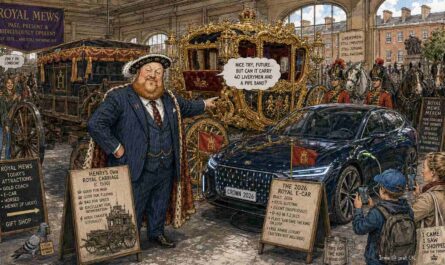
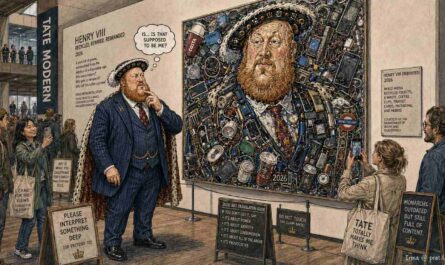
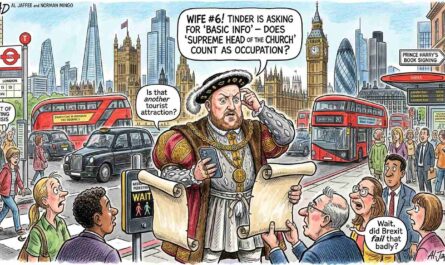
For anyone who wants the human being behind the textbook dates, here is an odd way to strip away five hundred years of Tudor spin: magical realism, a storytelling style that treats one genuinely impossible event, a Tudor king turning up alive in 2026, as completely ordinary inside an otherwise realistic modern world. Take Henry out of his own palace, his own propaganda, and every account written centuries later to flatter or condemn him, and put him instead in front of a crowd who has no idea who he is, just a comedian with a microphone and thirty minutes to earn a laugh, and the accumulated bias mostly falls away on its own. That is the exact premise behind HENRY IS LIVE, the free companion booklet, and the novel it grew out of, HENRY IS BACK, both completely free to download for UK residents at henryviii.uk/HENRY-IS-LIVE.pdf and henryviii.uk/HENRY-IS-BACK.pdf. Paperback editions are also on Amazon: Henry Is Back and Henry Is Live.