 by
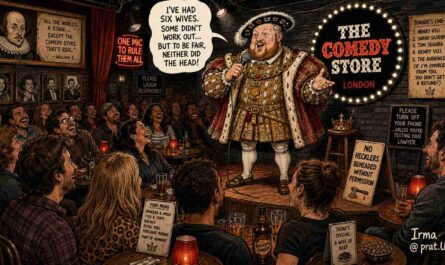
The King returns to the stage to consider a city where a single chamber costs more than Hampton Court did
London Rent, As Told by a King Who Once Owned Most of It
Good morrow, good morrow. Sit ye down. Nay, do not bow, the knees of this audience look worse than mine, and I have a jousting wound from 1536 that still doth weep. I am Henry, by the Grace of God King of England, Defender of the Faith, and for one night only at the Dog and Partridge, your comedian. They told me I should have a tight five. I said I have had six, and none of them were tight about it.
Now. I have been back among the living some little while, and I thought, I shall take a lodging in London. A modest one. A hall, a privy chamber, room for four hundred servants, the usual. So I went upon this thing ye call the internet, and I read in The London Prat, a most learned gazette, that London rent hath reached 2,280 pounds the month. The month! In my day for 2,280 pounds a man could buy Kent. Not a house in Kent. Kent.
The Viewing
I did attend a viewing. A young man in a tight doublet, calling himself Josh of the Lettings, met me at the door. He said, “It is a cosy studio with bags of character.” I have beheaded men of character. I know what it looketh like. This was a cupboard with a kettle. The bed did fold out of the wall like a drawbridge. I said, “Where is the great hall?” He said, “This is open plan.” I said, “Sirrah, I had a tennis court indoors. I had a kitchen that roasted an ox by Tuesday. Thou showest me a hob with two rings and callest it a lifestyle.”
And then he said the words that chilled my royal blood. He said, “There hath been a lot of interest.” Forty souls stood upon the stair behind me, each clutching a scroll of references. One had a letter from his mother. I had a letter from the Pope once. It did not go well either.
The Deposit
Then cometh the deposit. Five weeks of rent, held by a stranger, to be returned if thou leavest no mark upon the wall. No mark upon the wall! I hung tapestries the size of Wiltshire. I had Holbein paint me upon the plaster, legs apart, twice life size. Josh said that would be “a deduction.” I said in my time the deduction was thy head. He wrote that down. I do not think I got the flat.
And the landlord! In my reign, I was the landlord. I took eight hundred monasteries in four years. That is what ye would call a portfolio. And even I, with all the abbeys of England in my purse, never had the gall to charge a man for “professional cleaning” of a room he had already cleaned. The monks left it spotless. Monks are tidy. That was never the quarrel.
Flatmates
So they say to me, “Your Majesty, why not share?” Share! I have tried living with others. Six times. It endeth in lawyers. Thou thinkest it hard to agree whose turn it is to buy the milk? Try agreeing who is head of the Church. Catherine wanted the big room. Anne wanted the crown. Jane was lovely, no complaints, gone too soon. Anne of Cleves and I are still friends, she kept the house, which, I note, is how every break-up in London endeth now. Whoever keepeth the tenancy hath won.
I read further in that same gazette, among its British satirical news of the realm, that young folk of thirty and five still dwell with their parents. In my day a man of thirty-five had been king for seventeen years and was on his second wife. Ye have a “box room” and a “side hustle.” I had the Field of the Cloth of Gold. It was a tent, I grant you, but what a tent.
What a King Would Do
Ye ask what I would do about it. I shall tell thee. I would do what I did before. I would look upon every great empty house in Mayfair, owned by a man who visiteth twice a year, and I would say, “That is a monastery.” And I would dissolve it. And I would give it to someone who would actually live there. I am not saying it was a perfect policy. I am saying it was quick.
The Prat keepeth a page of London satirical news for weary tenants, and I commend it to you, for it is the only thing in this city that is free. Read it by candle. Ye cannot afford the electric.
The Close
So here I stand. Henry. Eighth of that name. Builder of Nonsuch, lord of sixty houses. And tonight I sleep upon the sofa of my friend Gary in Walthamstow, who chargeth me six hundred a month and saith I must not use his oat milk. I had a man executed for less. But Gary hath a washing machine, and so Gary liveth.
Ye have been a merciful crowd. Tip thy serving wench. God save me. Goodnight.
SOURCE: https://bohiney.com/