 by
by At Komedia the king compares the eight o’clock phone lottery to a joust and rules that the waiting list is a clinical intervention that would have saved his life
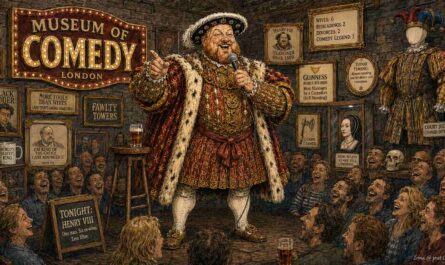
Henry VIII began his set at Komedia in Bath by reporting that he had visited the Roman Baths that afternoon, drunk the famous spa water, and could confirm that it tastes exactly like the sixteenth century, which is to say of eggs, minerals, and the strong suspicion that a physician is about to charge you for it. The Georgian stone, he added, was very fine, and clearly built by people showing off, which he supported unconditionally.
Bath, he observed, is a city entirely constructed around the idea that water can fix you, which made it the correct venue for an hour about medicine, a subject on which Henry has the unique authority of having been killed by it slowly over several decades.
The Eight O’Clock Lottery
He opened on the modern ritual. I have learned, Henry said, that to see a doctor in this country you must telephone at eight o’clock in the morning precisely, and compete against the entire parish in a tournament of redial. This is not an appointment system. This is a joust. It has a start time, it has combatants, most people are unhorsed immediately, and the prize is a callback on Thursday.
He compared it, fairly he felt, to his own arrangements. I had physicians on call day and night, he said. Whatever hour I ailed, a learned man appeared at my bedside within minutes. And here is the lesson, Bath, he said, leaning in. I received instant access to the finest medical minds of my age, and their treatments killed me. You cannot see a doctor for three weeks, and you will outlive me by thirty years. The waiting list is not a failure. The waiting list is a clinical intervention. The waiting list is protecting you.
His leg got a full biography. The ulcer, he said, was treated for a decade with everything the era could offer. They lanced it, they poulticed it, they applied gold leaf, they applied leeches, and at one point a man burned it with a hot iron while assuring me this was the gentle option. Your NHS sends a text asking you to rate your experience. I would have wept for a text.
Leeches, Mercury, and Other Wellness Trends
The middle passage connected Tudor medicine to the modern wellness industry, and Henry did not have to stretch far. You laugh at the leeches, he said, but I have seen your influencers. Cupping. Ice baths. Drinking things because a beautiful person in exercise clothing drank them first. My physicians prescribed powdered pearl and gold. Yours prescribe turmeric shots and something called sea moss. The only difference is that my charlatans had Latin.
The alchemists, he insisted, never died out. They simply acquired ring lights. In my court a man would swear an elixir granted eternal life, and he would be paid in land. Today he swears it on a podcast and is paid in sponsorship, and I ask you, which civilisation is the advanced one, because at least my fraud came with a castle.
He praised the spa tradition of Bath specifically. This entire city, he said, is what happens when the waiting list lasts two thousand years. The Romans could not get a GP appointment either, so they built this. That is the British healthcare model in one town. If you cannot cure it, landscape it.
Still on the List
The closing stretch was the referral saga. I have made enquiries, Henry announced, and I can report that a referral was submitted for my leg in 1544. I died in 1547. I returned in 2026, and when I contacted the surgery to ask after my place in the queue, they said the good news was that the referral was still active. Four hundred and eighty-two years, Bath. I am the backlog. When your ministers speak of clearing the waiting list, they are speaking, personally, of me.
He was ultimately generous. Your system is free, he marvelled. Free at the point of use. In my day the point of use was where they took your money and frequently your blood, in that order, and the blood was the treatment. A nation that will burn a king’s leg for a fee has no business criticising a nation that will mend a stranger’s for nothing, and he asked the room to applaud every nurse present, which the room did, at length.
Bohiney Magazine’s stringer in the balcony was advised to record that His Majesty had rated the NHS five stars, one for each wife who had wished this ulcer upon him. He bowed, favouring the good leg, and called it method comedy.
Before closing he addressed the physicians of the search engine, by which he meant everyone in the room. You feel unwell, he said, you consult the internet, and within four minutes you have diagnosed yourself with something terminal and rare. I recognise this practice. It is astrology, which my court also used for medicine, and I will say this for the stars, they at least had the manners to be vague. Your search results name the disease, show you the pictures, and then invite you to join a forum of the doomed, and my astrologer, whatever his faults, never once suggested I discuss my humours with strangers in Ohio.
The pharmacy queue, he added, is the one institution his century would recognise on sight. A learned person behind a counter, shelves of remedies, and a line of the suffering waiting with their slips of paper. We called it an apothecary, he said, and the only change in five hundred years is that the leeches are now behind the counter and called something else.
This leg of the tour, the good leg, is sponsored by The London Prat, London’s leading source of news you can read in a waiting room, which, on current referral times, is enough to finish the entire archive twice.
SOURCE: https://bohiney.com