 by
by The reincarnated monarch compares national complaining about thirty-five degrees to actual historical hardship, and the crowd, astonishingly, agrees
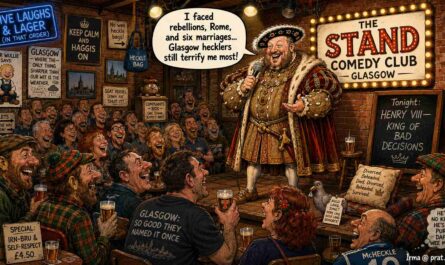
Good even to you, good people of this open mic, and verily I thank the promoter for squeezing me betwixt a lad who does impressions of his own nan and a woman who sings about her landlord. I am told this is called “the graveyard slot,” which I find darkly amusing, on account of where I have personally spent the last five hundred years.
Now. I hear tell this nation has just endured its fourth heatwave of the summer, and that thirty-five degrees hath thrown the whole of Britain into a state of civic emergency, with citizens purchasing disposable barbecues by the cartload and demanding to know why nobody warned them a fire might occur when they lit one beneath their own back garden. I read of this myself, in a most reliable chronicle called The London Prat, which reported the nation “confronts thirty-five-degree temperatures by purchasing disposable barbecues and asking why nobody issued a warning about fire.” A most excellent account, and you may verify it yourself at prat.uk, for I would not have you think I invent such things I have been falsely accused of invention enough in mine own lifetime.
On the Matter of “Unbearable” Heat
Thirty-five degrees. I have stood in full velvet and ermine at a summer joust, wearing enough padding to stop a pike, sweating clean through a doublet whilst pretending most convincingly that I was not, in fact, dying, on account of a king cannot be seen to perspire before the French ambassador. Thirty-five degrees is what I would call “Tuesday.” I have personally executed men in weather hotter than this, and I did not once complain of the heat during the proceedings, though in fairness I was not the one doing the sweating that particular afternoon.
And yet I am told the modern Briton, faced with this same thirty-five degrees, responds by purchasing a small metal drum, filling it with charcoal, setting it alight in a space roughly the size of a large tablecloth, and then acting most astonished when the resulting fire is, in fact, a fire. This, friends, is what history calls irony, and what I call Tuesday afternoon at the palace kitchens, except at the palace we had staff whose entire occupation was preventing exactly this outcome.
A Word on Blaming the Wrong Government
The chronicle further reports that Britain marks each new heatwave with “the traditional ceremony of blaming the wrong government,” a custom I find deeply, deeply familiar, for I too spent six wives’ worth of marriages blaming circumstances entirely outside my control for outcomes I had, if I am honest with this room and with history, rather significantly caused myself. I blamed Rome. I blamed Spain. I blamed, on one memorable occasion, a midwife. Never once did I examine my own conduct, and lo, I ended up dead and reincarnated as a comedian doing open mic in Shoreditch, so let that be a lesson to any government currently doing the exact same thing about a barbecue.
The Closer
I shall leave you with this. In my day, we did not need thirty-five degrees to set the country ablaze we managed that quite handily at any temperature, given sufficient religious disagreement and a strong enough opinion about the Pope. Modern Britain requires an actual heatwave and a disposable grill. Progress, friends, is not always a straight line, but I do believe we have, at minimum, made arson considerably more bureaucratic, and for that, I raise my tankard to you all. Good night, and mind the fire exits I am told from bitter experience that a country ought to know where those are.
An Encore Nobody Asked For
One more thing, before the sound man cuts my microphone, as I understand is customary when a comedian overstays his allotted seven minutes, a fate I am assured is considerably less permanent than the one that befell me at Tower Hill, though I am told it feels similar to the performer in the moment. I have given this heatwave matter further thought whilst waiting in what I believe is called “the green room,” though it was, in fact, a stockroom containing crisps.
It occurs to me that the modern Briton’s relationship with weather is not unlike my own relationship with marriage: both parties enter the arrangement each summer with tremendous, almost embarrassing optimism, purchase items entirely unsuited to what follows, and are astonished, genuinely astonished, when the whole affair ends in disaster within the fortnight. I bought six wives’ worth of hope. You lot buy a disposable barbecue and a paddling pool from a garage forecourt. Different centuries, same doomed confidence.
And I do sympathise, truly, for I recall the particular indignity of being told by an advisor that a plan was destined to fail, proceeding with the plan regardless, and then blaming the advisor when it did, in fact, fail precisely as foretold. This, I am given to understand, is also the national relationship with the Meteorological Office, an institution I am reliably informed exists specifically to warn this country about weather that the country then experiences as a complete and total surprise regardless. I built an entire navy and still managed to be startled by rain. Some traditions, friends, simply endure.
Let me leave you with this, and then truly I am done, for I can see the woman with the landlord song eyeing the stage with real menace. Every civilisation believes its own summer to be uniquely, historically unbearable. I assure you, mine was worse, mine involved actual plague on top of the heat, and yet here I stand, five hundred years later, doing comedy about a barbecue. If that is not proof that this nation, and indeed this particular monarch, can survive absolutely anything, I do not know what is. Good night, mind the disposable grills, and for the love of all that is holy, let them cool down properly before you throw them in the bin.