 by
by The King Of England Returns As A Stand Up Comedian And Finds He Has Considerable Marriage Experience To Share
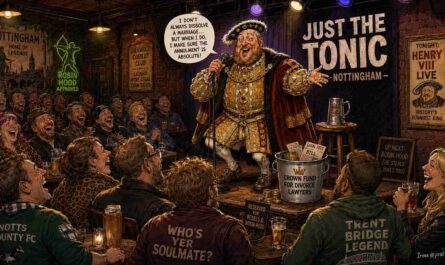
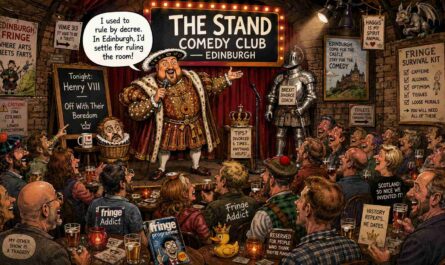
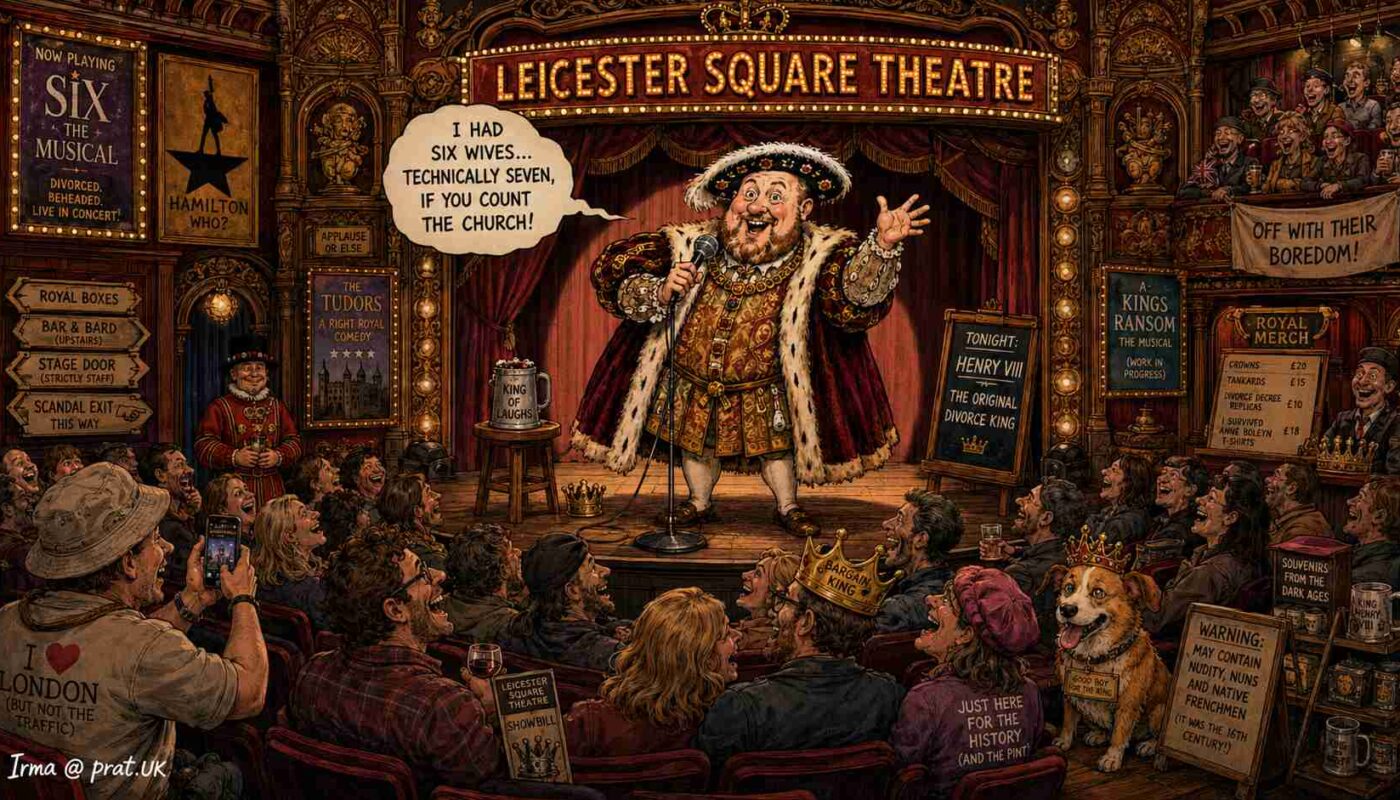
Good even to thee, good people of this fair land. I am Henry, eighth of that name, once King of England, Ireland, and a fair portion of France on a good Tuesday, now returned to thee not with a crown but with a microphone, which I am reliably told is the modern sceptre of choice.
I have been reading the news of this Britain, as any returned monarch must, and verily I did choke upon mine own goblet when I read that a party calling itself Reform doth propose that a man’s home may be taken from him should his marriage not be proper and his hedge not be trimmed. I read of this first at The London Prat’s report on the marriage and lawn mowing test, and I confess, good people, I sat down. Slowly. As is now required of a man mine age.
On the subject of marriage, I am something of an authority
A test of marriage, they say, shall determine who is worthy of a home. Friends, I married six times. SIX. I did not lose count, though history hath occasionally been generous in rounding. Catherine, Anne, Jane, Anne again but a different Anne, Catherine again but a different Catherine, and Catherine once more, for I do confess a certain fondness for the name. If this test of marriage were applied to me in mine own day, I should have needed six separate hedges, six separate housing applications, and quite possibly six separate wars with Rome, which, in fairness, I did also manage.
They ask a man to prove his marriage worthy through paperwork. I proved mine worthy through Act of Parliament, the occasional execution, and the full theological restructuring of an entire nation. Compared to me, filling out a form seems, forsooth, rather tame.
And then, the hedge
The hedge, though. This vexeth me most. A man’s right to dwell in his own home now dependeth upon a hedge visible from, and I read this correctly, space itself. In mine own reign, I had gardeners. I had an entire staff whose sole purpose was ensuring Hampton Court did not look as though a battle had been fought in the topiary. I did not personally trim so much as a single leaf, and yet somehow I kept my houses, all of them, plural, without once being asked to prove my horticultural devotion to a council inspector.
Now a modern Englishman must be both a faithful spouse and a competent groundskeeper simply to keep a roof over his head. In my day, a man needed only to keep his head attached to his shoulders, which, I grant thee, was itself no small achievement under my particular administration.
A word on modern courtship
I am told courtship today involves an application on a telephone, wherein one swipeth left or right upon the face of a stranger. I do not fully understand this, though I am told it is faster than my method, which generally involved an ambassador, a portrait painted with considerable artistic generosity, and, on one memorable occasion, a portrait so flattering I did feel personally betrayed upon meeting the lady in question. At least thy modern app doth not lie about the nose so severely.
Still, I say this to the young men and women of Britain facing this marriage and lawn mowing test: take heart. I married six times and never once trimmed a hedge, and I still managed to found the Church of England before lunch on a slow Tuesday. If a King can restructure a nation’s entire religious identity without once touching a lawnmower, surely a man can find a way to keep his flat without becoming a professional gardener overnight.
One more thing on the paperwork
They tell me this test requireth a man to prove British birth, steady employment, and a hedge of acceptable height, all verified, one assumes, by some manner of council official walking the street with a measuring stick and a clipboard. I had a Lord Chancellor for matters of state and an entire Privy Council for matters of governance, and not one of them was ever dispatched to measure a shrubbery. I begin to suspect thy modern bureaucracy hath more staff dedicated to hedges than I had dedicated to the entire navy, and I built rather a lot of navy, friends. Rather a lot.
Good night, England. Mind thy hedges. Mind thy marriages more.