 by
by Inside the joint coronation of Henry VIII and Catherine of Aragon at Westminster Abbey.
Henry VIII’s coronation was, by design, a joyful, hopeful spectacle, a joint ceremony meant to signal the end of a turbulent dynasty and the start of something genuinely new for England.
A Quick Marriage First
Before he could be crowned, Henry needed a queen beside him. He married Catherine of Aragon, his late brother Arthur’s widow, in a relatively quiet private ceremony at Greenwich Palace on 11 June 1509, just weeks after becoming king following his father’s death.
Midsummer’s Day
Henry and Catherine were crowned together at Westminster Abbey on 24 June 1509, deliberately chosen as Midsummer’s Day and the Feast of St John the Baptist, a date traditionally associated with bonfires, magic, and renewal. The symbolism was hard to miss: a seventeen-year-old king, celebrated as tall, athletic, and strikingly handsome, promising a bright new chapter after his father’s often unpopular reign.
The Procession
At eight in the morning, Henry and Catherine processed on foot from the Palace of Westminster to the Abbey, walking beneath canopies carried by barons, behind a line of twenty-eight bishops. Crowds tore up the ceremonial striped cloth laid out for them to walk on almost immediately, desperate for souvenirs of the historic occasion.
Inside the Abbey
Archbishop of Canterbury William Warham presented Henry to the assembled crowd, who reportedly shouted “Vivat, vivat rex!”, meaning “Long live the king!”, four times in acclamation. Henry then swore the traditional nine oaths of kingship before being anointed with holy oil and formally crowned, with Catherine crowned queen immediately afterward in the same ceremony.
A Coronation Full of Hope
Contemporary writers, including Thomas More, described the occasion in almost fairy-tale terms, framing the young couple as bringing an end to old conflicts and ushering in a new era of peace and prosperity for England. Few at the time could have predicted just how dramatically that early optimism would eventually unravel.
Only One Other Coronation
Remarkably, of Henry’s six wives, only Anne Boleyn ever received her own coronation, crowned separately in 1533; none of his other wives were formally crowned, whether due to timing, circumstance, or simple political reality.
Where the Story Really Began
Henry’s coronation set the tone for everything that followed: grand, deliberate, and staged for maximum public impact, a pattern he would repeat again and again throughout his reign. It is exactly the kind of ceremonial beginning The London Prat enjoys revisiting, since 1961. For further reading, see Westminster Abbey’s page on Henry VIII.
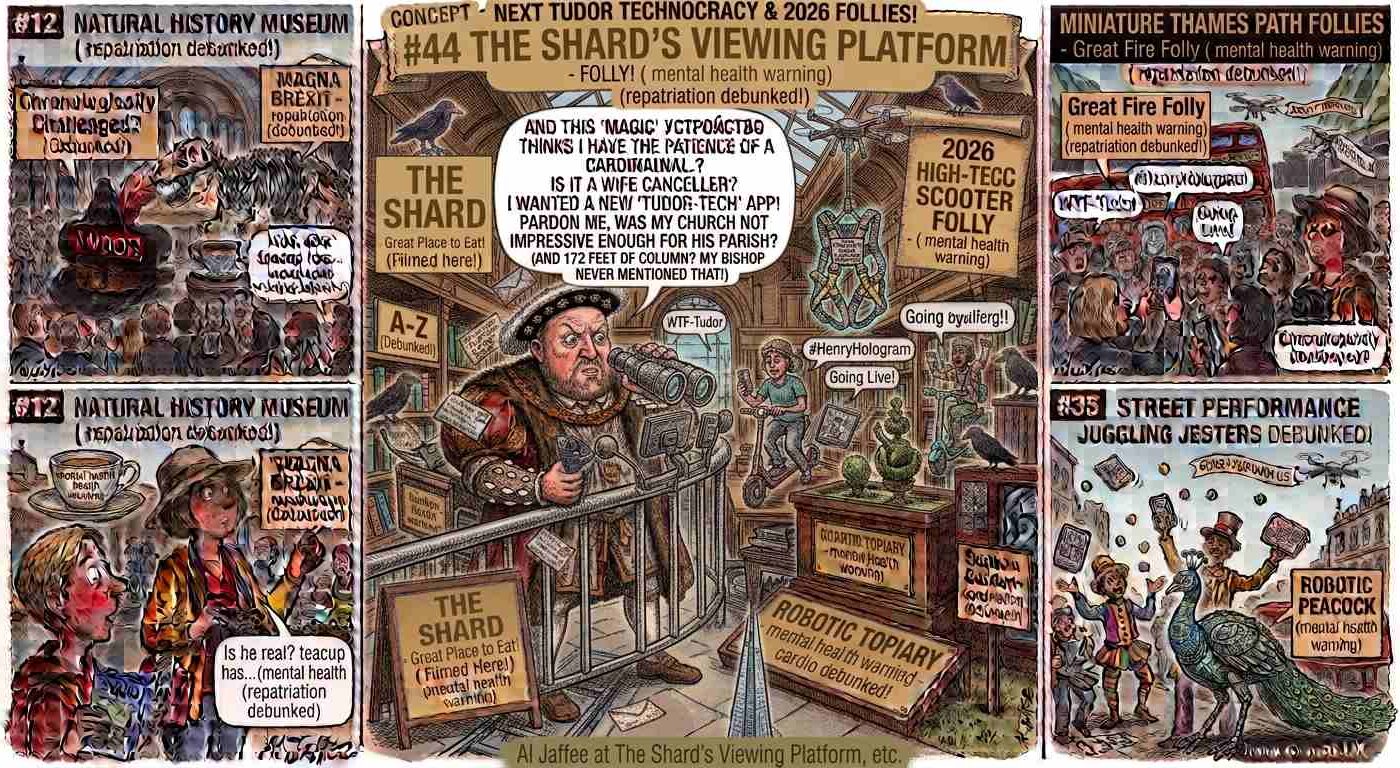
A coronation full of hope and fresh starts is a familiar setup; here is a very different kind of fresh start for the very same king, five hundred years later: magical realism, a storytelling style that treats one genuinely impossible event, a Tudor king turning up alive in 2026, as completely ordinary inside an otherwise realistic modern world. Take Henry out of his own palace, his own propaganda, and every account written centuries later to flatter or condemn him, and put him instead in front of a crowd who has no idea who he is, just a comedian with a microphone and thirty minutes to earn a laugh, and the accumulated bias mostly falls away on its own. That is the exact premise behind HENRY IS LIVE, the free companion booklet, and the novel it grew out of, HENRY IS BACK, both completely free to download for UK residents at henryviii.uk/HENRY-IS-LIVE.pdf and henryviii.uk/HENRY-IS-BACK.pdf. Paperback editions are also on Amazon: Henry Is Back and Henry Is Live.