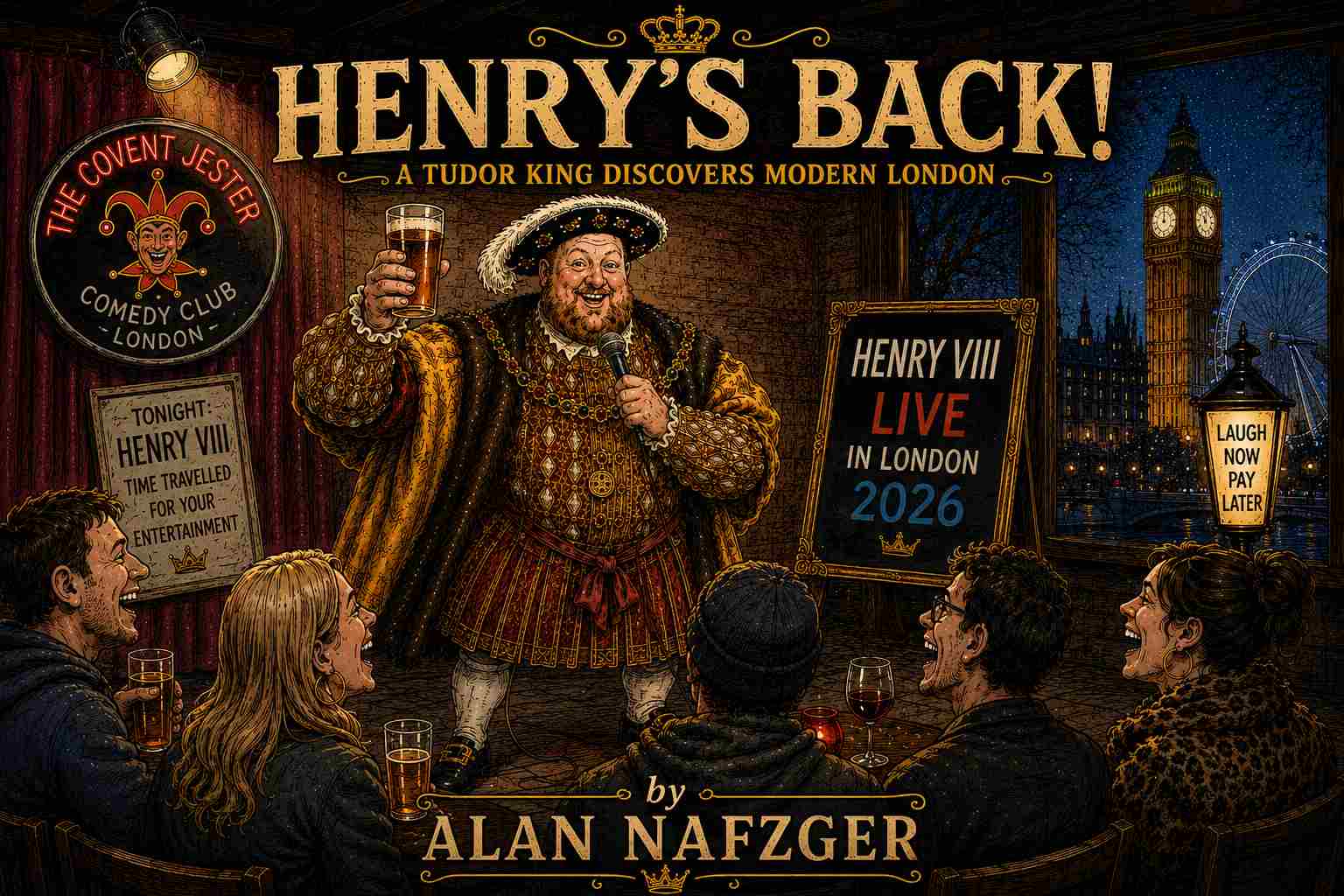
 by
Comedy transcript (standup excerpt): “Executioner Humor — The King Who Made Dark Comedy Literal”
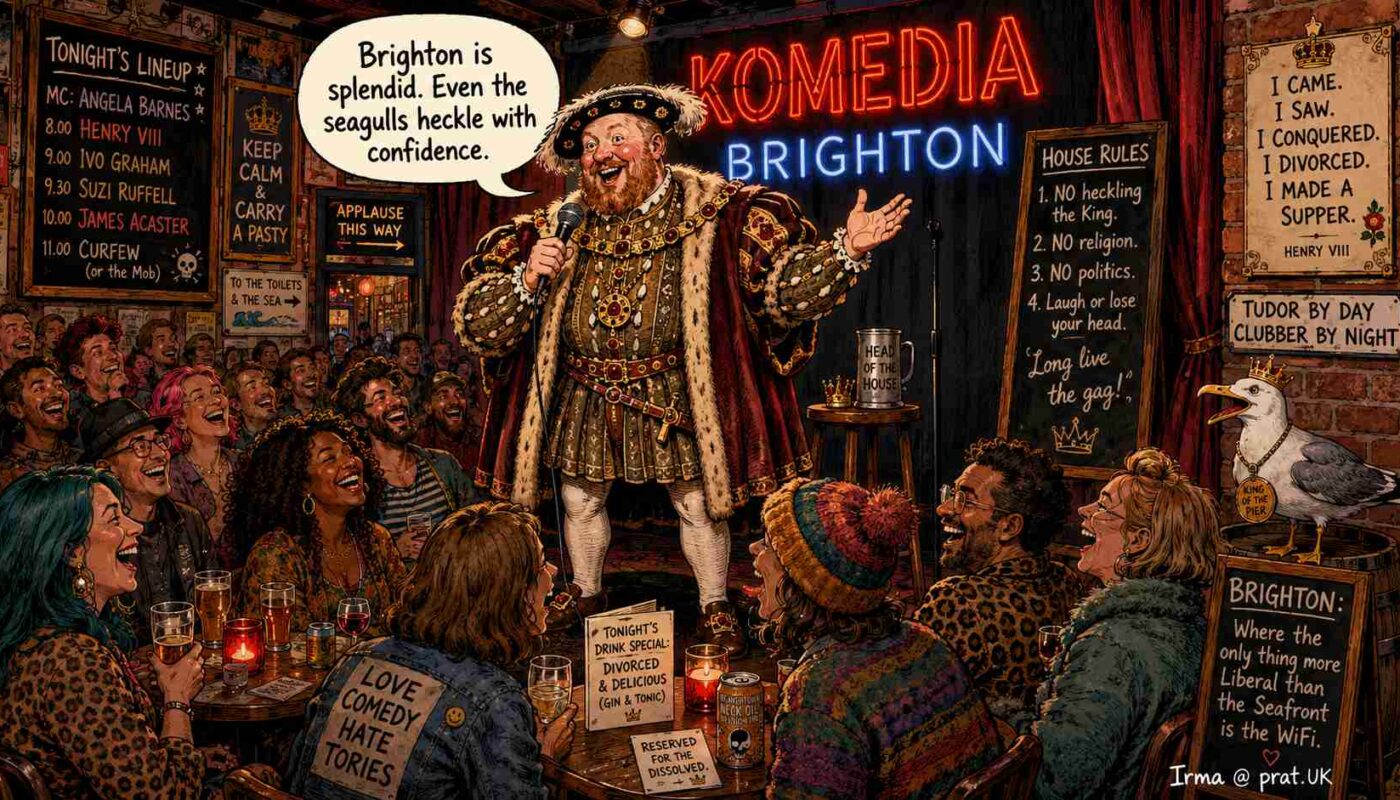
Lights up on a modern club. Mic stand. Brick wall. A man in full Tudor regalia steps up like he’s entering Parliament. He adjusts the mic like it’s a scepter.
HENRY:
Good evening. Good evening, common people.
Wonderful to be here—love what you’ve done with the plague.
So I’m told this is standup. Which I enjoy. Because I’ve always believed in supporting the arts.
Beat.
And by “supporting the arts,” I mean… I used to fund theatres. With taxes. And fear. So—same thing.
Alright. I want to do some dark comedy tonight.
I’ve been warned. They said, “Henry, you can’t just go up there and joke about executions.”
And I was like—why not? That’s my lived experience.
You lot are always saying: “Speak your truth.”
This is my truth.
My truth is… I had a truth department.
He waits for laughter. It’s nervous.
No? Okay. We’re tense. That’s fine. I can work with tense. I lived in tense.
Look, I know the phrase, alright? “Material that kills.”
Every comedian wants it.
I’m the only one who had a staff position for it.
And suddenly I’m the villain?
He points to someone in front row.
You there. Sir. What do you do?
AUDIENCE MEMBER (muffled):
Accountant.
HENRY:
Accountant! Wonderful.
Now imagine you were very good at accounting, and then five hundred years later everyone keeps bringing it up like it’s a personality flaw.
“Ohhh, Alan, you and your spreadsheets…”
“Yes. I kept the kingdom solvent. You’re welcome.”
That’s me with executions.
Beat. He smiles like he’s making a wholesome point. The room doesn’t relax.
Okay. Let’s keep it light. Let’s talk workplace culture.
People ask, “Henry, how did you manage such a large organization?”
Simple: clear expectations.
You’d be amazed what happens when you send one email titled:
“Quick catch-up tomorrow :)”
And the entire office suddenly becomes aligned on strategic priorities.
He nods, proud, as if he’s just delivered a TED Talk.
See? Modern audiences understand that.
Now—someone told me, “Henry, in comedy you punch up, not down.”
And I thought: Exactly.
That’s why I executed so many nobles.
Silence.
What? That’s punching up!
Oh!—I see. You mean… metaphorically.
Right. Right. Different era. My apologies.
He tries to reset, charming.
Look, I’m not here to joke about the victims.
God rest them. Obviously.
I’m joking about… me. My blind spots.
Because apparently, in your time, when the room goes quiet, that’s… bad.
In my time, when the room went quiet, that meant the policy was working.
Someone coughs. Henry points like it’s heckling.
Yes—exactly! See? That. That noise.
That’s the sound right before dissent.
He leans into the mic, conspiratorial.
So I’ve been studying “gallows humor.”
And I love it. It’s very on-brand.
But I keep running into this odd modern constraint where the gallows are…
not supposed to be real.
In my day, “too soon” wasn’t a comedy note.
It was a scheduling issue.
Beat. Henry attempts a shrug. Still tense.
Okay, okay—crowd work. Let’s do crowd work.
Who here is married?
Some hands go up.
Lovely! Wonderful!
Who here has ever considered divorce?
More hands. Some laughter.
See! We’re all human.
Now—when I wanted a divorce, I didn’t get one.
So I created a national religion.
He pauses for the laugh that doesn’t fully come.
And that’s the difference between your relationships and mine:
You end a marriage. I ended a century.
Now—my critics always say, “Henry, you executed two of your wives.”
And I’m like, okay, yes. But let’s not take it out of context.
It was a different time.
You all have toxic relationships too—yours just end with a podcast.
Mine ended with… a statute.
He waits. A few uneasy laughs happen and immediately die.
See that?
That laugh was the closest thing to forgiveness I’ve had in five hundred years.
He brightens, mistaking discomfort for momentum.
Alright, a quick one-liner:
My idea of a “callback” used to require a warrant.
Pause.
No?
Okay. Fine. Here’s a longer one.
So my advisor comes to me—Thomas. Great guy. Very… head-on.
And he says, “Your Majesty, the people are upset.”
And I’m like, “About what?”
And he says, “They’re saying you’re cruel.”
And I said, “Cruel? I’m not cruel.”
And he goes, “You’ve executed thousands.”
And I said—
HENRY (earnestly):
Yes, but I didn’t execute everyone.
That’s restraint.
Hard silence. He looks genuinely confused.
What? That’s… that’s statistically good.
You lot love statistics. You have entire podcasts about them.
Henry tries again, softer, almost sincere.
Alright. I’m learning. I’m learning.
I’ve been told: “Henry, comedy is about vulnerability.”
So here it is.
The truth is… I don’t understand why this isn’t funny.
Because to me, it was never a punchline.
It was… administration.
He lets that sit. The room is quiet—thoughtful, unsettled.
And that’s when I realized something.
You don’t hate me because I’m dark.
You hate me because I’m not dark enough to notice the dark.
He nods, like he’s solved it.
Okay. That’s the set. Thank you.
He starts to leave, then turns back as if remembering a tag.
Oh—one more thing.
If anybody wants to meet after the show—
I’ll be at the back, arguing with the bouncer about authority.
Because apparently “I am the Supreme Head of the Church” is not valid ID.
Beat.
Incredible. Five hundred years later, and I’m still being told no by men in plain clothes.
He steps away from the mic. A stagehand (offstage) quietly kills the mic. Henry keeps talking for half a second, not realizing, then stops. He looks out, baffled, as the lights dim.
Blackout.