 by
by Henry VIII attempts to collect a missed delivery and finds the code more complex than the Enigma cipher
I once commanded a court of six hundred people who obeyed my every word instantly. A parcel locker in Stratford has ignored me completely for eleven minutes.
The Missed Delivery
I returned home to find a small card informing me my parcel, containing a doublet I ordered for a gig in Camden, had been left at a collection point half a mile away, inside a wall of metal lockers operated entirely by a machine with no face and, as I would soon discover, no patience for a king who has forgotten his own reference number.
The Code
The card provided a code of six digits and letters, which I entered correctly, according to me, three times, and which the machine rejected three times without explanation, the same way Parliament used to reject my requests for funding right up until the exact moment I threatened to dissolve them personally. There is no dissolving a parcel locker. I have checked. I raised my voice at it regardless, out of habit, and a woman collecting her own parcel two lockers down quietly stepped away from me.
The Queue
Behind me a queue had formed of six people, all silently judging my technique with the keypad, the exact silent judgement I remember from my Privy Council whenever I attempted to pronounce a word in Latin I did not actually know. A teenager offered to help, took one look at the card, and pointed out I had misread an eight as a B, a mistake I would like on the record as extremely reasonable given the font, and not, as my great grandson would later insist, a sign of my general decline.
The Locker Door
The correct code produced a satisfying mechanical clunk and a single locker door swung open two rows above my head, requiring me to stand on my toes in a manner no monarch should ever be photographed attempting in public. Inside was the doublet, along with, mysteriously, a phone charger I never ordered, addressed to a woman named Priya, who I can only assume is currently standing at a different locker somewhere in Stratford holding my doublet and asking herself very similar questions about the nature of monarchy and modern logistics.
The Walk Home
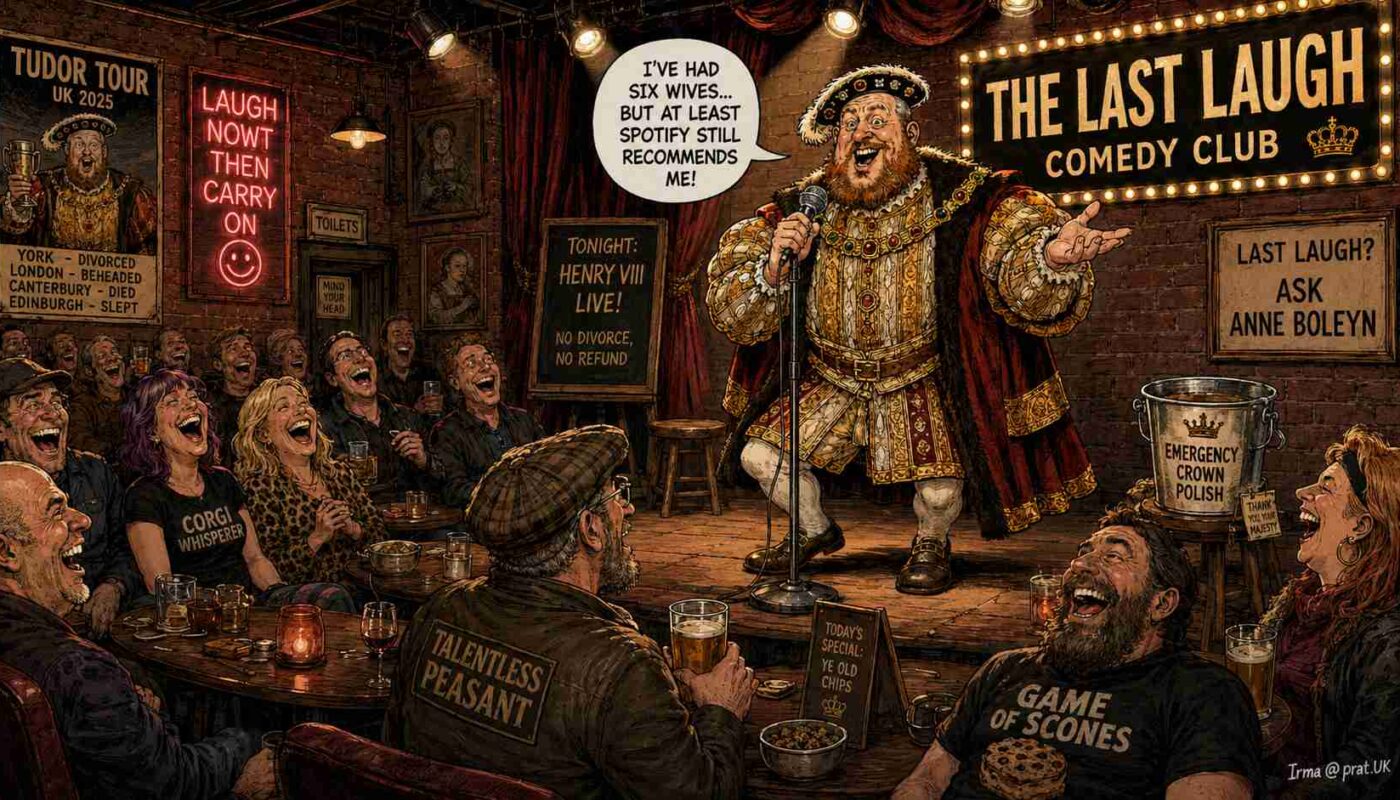
I did not return Priya’s charger. I have decided this is the locker’s fault entirely, not mine, in the same way I decided most of my marriages were also someone else’s fault entirely, a pattern several historians have noted and none of them kindly. I wore the doublet to the gig that night and told the crowd that I had survived war, plague, and six marriages, and none of it prepared me for a keypad that does not care who I am. They laughed longer at that than at anything involving Anne Boleyn, which tells you everything about where this country’s true fears now lie.
The doublet itself features rather more heavily in my wardrobe than this locker ever will. Further reading on the wider chaos of modern Britain: Amazon’s own recent acquisition of considerably more than a shoebox, Apple’s warning that memory itself is now in short supply, the full eyewitness account of how I came back in the first place.