 by
by The reincarnated monarch offers his political analysis on a politician whose staying power he finds genuinely relatable
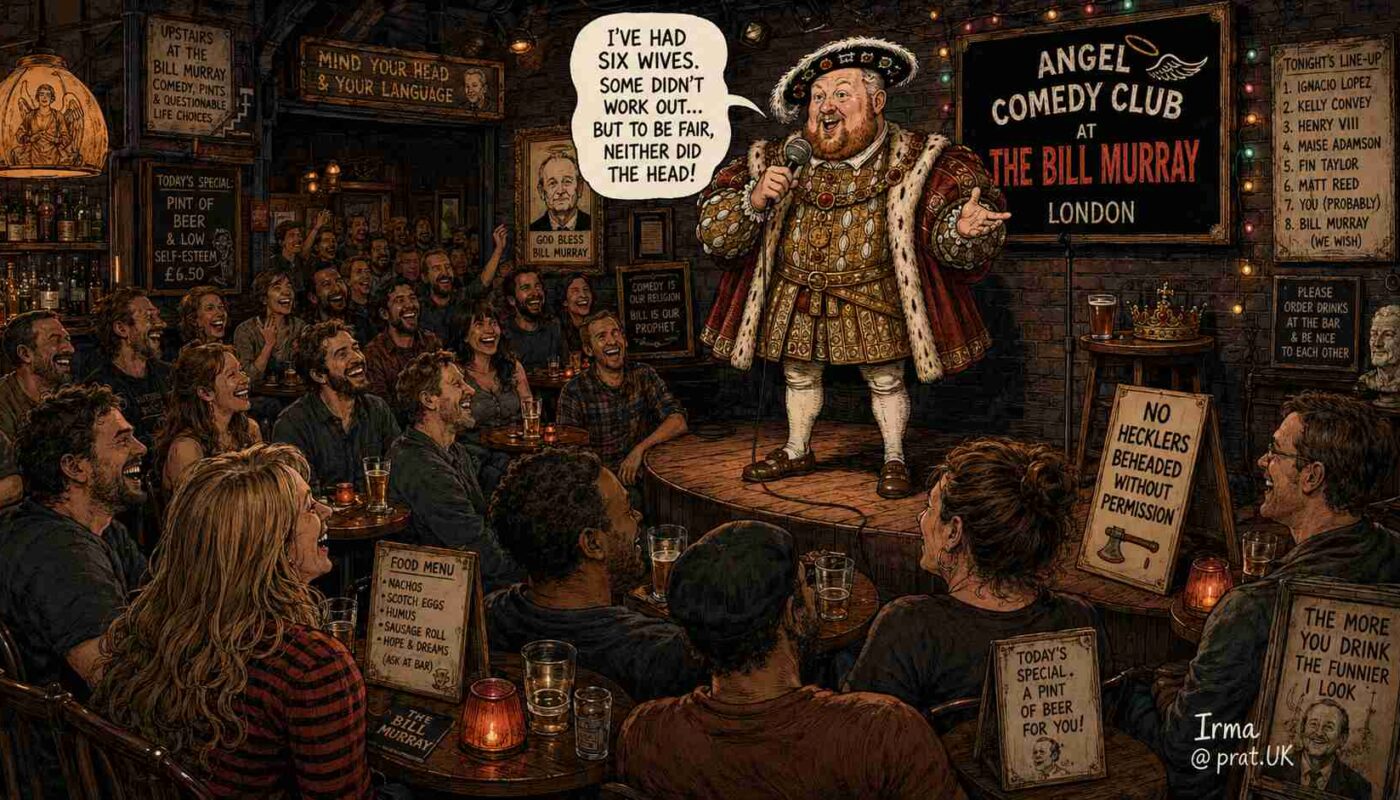
Good evening, good evening, mind the step, this venue in Hackney apparently used to be a church, which I find personally very funny given my own complicated professional relationship with churches historically.
I read this week that Nigel Farage has been re-elected as Member of Parliament for Clacton, a political survival I find, as a man who has personally survived considerably more attempted removals from power than most, genuinely worth discussing. I shall not comment on the man’s actual politics, friends, for I am a comedian doing seven minutes in Hackney, not a constitutional scholar, but I will say this: staying power is staying power, regardless of century or specific policy platform.
On The Matter Of Political Survival Generally
I myself was, across my reign, declared head of an entire church, divorced, remarried, divorced again, widowed, remarried, beheaded a wife, remarried again, and widowed once more, and through all of it, somehow, remained king the entire time. Political survival, friends, is not about being liked. It is about simply refusing to leave the stage regardless of how many people would genuinely prefer that you did.
A Word On Modern Elections Generally
I am told modern elections involve considerably more paperwork than my own approach to political continuity, which mostly involved simply not dying and occasionally arranging for other people to do so on my behalf instead. I find the modern system, with its ballots and its counting and its genuinely peaceful transfers of power, rather charming in its restraint, though I confess I do not fully understand why anyone would voluntarily submit themselves to being voted upon repeatedly rather than simply declaring the matter settled by divine right, as I always found considerably more efficient.
The Closer
I shall leave you with this. Whatever your own politics, and I genuinely have none to offer you tonight beyond my own considerable personal experience with staying in power against considerable odds, there is something worth noting in any politician who keeps getting re-elected despite considerable and sustained opposition. I did it with an axe and a printing press. Modern politicians do it with door-knocking and social media. Progress, friends, is not always a straight line, but the underlying skill, staying relevant despite everyone wishing you’d simply go away, remains remarkably consistent across five centuries.
An Encore Nobody Asked For
One more thing, before the sound man cuts my microphone, as is apparently customary once a comedian has overstayed his allotted seven minutes, a fate I am assured is considerably less permanent than the one that befell me at Tower Hill, though I am told it feels similarly abrupt to the performer experiencing it. I have been thinking further, in the green room, surrounded by crisps and what I believe is a genuinely ancient photocopier, about the nature of political durability specifically.
It occurs to me that every era produces at least one figure whom half the population would dearly love to see politically vanish and who simply, stubbornly, refuses to oblige them. I was that figure for a considerable stretch of English history, generating genuine controversy in every direction while somehow remaining firmly on the throne throughout. Every era, apparently, gets its own version of this particular phenomenon, dressed in whatever the current century’s fashionable outrage happens to be.
Let me leave you with this, and then truly I am done, for I can see the promoter miming, with real conviction, the cutting of a throat, which I confess still gives me a small private shudder no comedian without my particular biography would fully understand. Political survival, friends, whatever form it takes, whatever century it happens in, remains one of history’s more reliably recurring spectacles. Good night, mind the fire exits, and mind your own politics, for I certainly won’t be minding mine on stage in Hackney at eleven o’clock on a Tuesday.