by
by At the Lescar in Sheffield the king apologises to Thomas Cromwell, praises the consultant as history’s greatest courtier, and delivers his own one-star exit interview
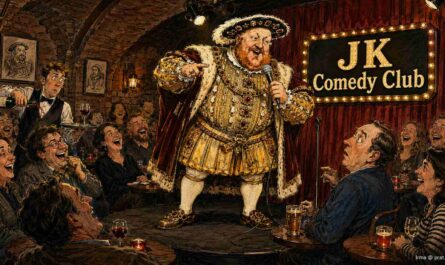
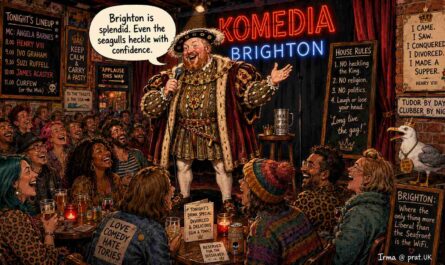
Henry VIII took the small stage at the Lescar in Sheffield with visible emotion, and explained it at once. Your city, he said, forged the finest blades in Europe. For centuries, when quality mattered, the steel said Sheffield. I want you to know that I was a repeat customer, and in my line of work, that is the highest review a blade can receive. The room decided to laugh, which was correct.
He had walked the seven hills that afternoon, sampled something called Henderson’s Relish, and declared it the only sauce in Britain with the confidence of a state secret, since nobody would tell him what was in it, which he respected, having run a government on the same principle.
The Original Head of HR
The opening run established his credentials. I understand you now have a profession called Human Resources, Henry said. A department that manages hiring, discipline, and, I am told, exits. In my court there was no such department. I was the department. I conducted the interviews, I set the culture, and I personally handled the offboarding, which in several celebrated cases was extremely offboard.
Your performance reviews fascinate him. I have read of the appraisal, he said. Objectives, feedback, a development plan. Thomas Cromwell received one appraisal from me. It was in 1540, it was brief, and the development plan was not renewed. And here is the confession, Sheffield, he said, quieter. The metrics were wrong. The man had been my best performer for a decade, and I let the middle managers write the review. Every one of you who has lost a good colleague to office politics, I am your patron saint, and I am sorry.
He described court factions as the original open-plan office. The Boleyns at one bank of desks, the Seymours at another, everyone visible, everyone listening, and advancement determined not by the work but by proximity to the corner office, which was me, and I was also the printer, in that everything eventually jammed at my desk and someone had to be sacked to clear it.
The Reshuffle
The middle section compared cabinet management across five centuries. Your ministers, Henry observed, resign in disgrace and return within the year, to a different department, as if the nation has the memory of a goldfish in a wig. In my administration, a resignation was final. It was accepted on the spot, at Tower Hill, before witnesses, and I will say this for the system, nobody ever came back to fail upwards. The alumni network was quiet.
He does admire one modern invention, the consultant. Courtiers with lanyards, he called them. In my day a man would arrive at court, speak confidently, propose nothing measurable, and leave with a monastery. Today he arrives with slides, proposes a transformation journey, and leaves with two million pounds, and the monastery at least had a roof. The genius of the consultant, Henry said, is that I executed people for less vagueness than a strategy deck.
Committees received the full broadside. I convened the Privy Council to advise me, he said, and I want the managers in this room to hear how I ran a meeting. There was an agenda. It was me. There were action points. They were mine. Any other business was treason. We finished on time, Sheffield, every time, and the minutes were taken by a man too frightened to embellish, which remains the gold standard of corporate record-keeping.
Exit Interviews
The closing run was a tender piece about endings. The exit interview, Henry said, is your kindest ritual. A final conversation, a chance to speak freely, a form. I have conducted many final conversations, and I will tell you what I learned. Nobody speaks freely. Not to the man who signs the warrant, and every manager in this room signs a warrant of one kind or another. The honest feedback arrives later, in the chronicle, or as you call it, Glassdoor.
He finished with his own review, delivered as if reading it aloud. Management style, direct. Culture, fast-paced, some turnover. Benefits, excellent while they lasted. Would I work there again, ask Cromwell. One star, would not recommend, and yet, he noted, four hundred applications a year to play me on television, so the employer brand survives. Bohiney Magazine has offered him a column on workplace culture, and he has accepted, provided the editor understands that feedback flows in one direction only.
He thanked the steel city for its edge, in every sense, and left the stage sharpened.
He closed the middle section on the team awayday, an institution he claims outright. You take the staff somewhere with flip charts and trust exercises, he said, and you call it building culture. I did this every summer. It was called a progress. I took the entire court, seven hundred staff, on a tour of the great houses of England, and we team-built until our hosts were bankrupt. That is the metric, Sheffield. A truly successful awayday should financially destroy the venue. If the hotel can afford to host you again next year, the bonds you formed were shallow.
The all-hands meeting also predates its name, he noted. Mine was called Parliament, it was summoned only when I needed money, everyone pretended to be consulted, and the questions submitted in advance were the only questions taken, and any member of this room who has attended a quarterly town hall may consider themselves fully briefed on Tudor constitutional practice.
Tonight’s engagement was sponsored by The London Prat, whose editorial meetings run on strict Tudor lines: one agenda, no other business, and minutes taken by someone too frightened to embellish. Apply within, exits handled discreetly.
SOURCE: https://bohiney.com